Community News
Blackburn College files lawsuit against contractor following Jewell Hall problems


Blackburn College is suing Henson-Robinson Co., Springfield, for damages in excess of $600,000, claiming a heat-pump system the company designed and installed in a college dormitory was faulty, resulting in high humidity and causing mold to accumulate in virtual all the dorm rooms in the residence. The four-count lawsuit, alleging breach of contract, negligence, negligent misrepresentation and breach of fiduciary duties, further alleges the college has been forced to relocate students due to continuing issues with mold.
According to the suit, Blackburn contacted Henson-Robinson early in 2012 for advice and professional consultation for a new climate control system for Jewell Hall, reportedly the largest residential dormitory on the Carlinville campus. In February 2012, the defendant submitted a bid of $322,986 to provide a six-unit VRF-H2i heat pump system. Three months later, the defendant was one of three contractors submitting bids to install the equipment and the college accepted the defendant’s bid of $321,748 for that work. According to the suit, the installation was completed in 2013 and that from the onset, the “system experienced problems with functionality.”
According to the suit, the design of the system did not fit the space available for piping. As a result, the suit alleges, the college worked with Henson-Robinson to resolve the problems and, in the summer of 2013, the residence was turned over to Blackburn for student use. Once students began occupying the dormitory, the suit alleges, the condensate pumps immediately failed and additional sealing and leaks occurred, along with thermostat problems in virtually all of the dorm rooms. The plaintiff claims it “once again” worked with Henson-Robinson to resolve the issues.
By October 2014, the suit continues, student residents began reporting mold growth in dorm rooms and Blackburn was forced to relocate students while mold was cleaned. Between October 2014 and 2015, Blackburn worked to clean numerous instance of mold in dorm rooms, according to the suit. Despite those efforts, mold issues continued and by December 2016, the college vacated the building, and paid residents to move all their possessions into storage so Jewell Hall could be thoroughly inspected and cleaned. During that operation, mold was found in virtually every dorm room inspected, the suit claims.
“Despite Blackburn’s efforts, mold growth continued in Jewell Hall into the 2016 school year and thereafter,” according to the suit.
Because of the ongoing problems, Blackburn retained an environmental consultant to inspect the mold growth and determine its nature and cause. The college also consulted with a mechanical contractor to design a new climate control system to remediate the deficiencies with the system designed by Henson Robinson.
According to the suit, the consultants conclude that the mold growth was due to extreme humidity levels trapped in Jewell Hall by the system Henson-Robinson designed and installed. Additionally, the consultants reported that the six-unit VRF-H2i heat pump system was “over-designed” in such a manner as to create negative pressure in Jewell Hall, which significantly increased humidity and precipitated mold growth.
Confronted with the findings of the consultants, Henson-Robinson “shockingly denied” responsibility for the problems and advised that the excessive humidity could be alleviated by asking students to leave their dorm windows open, according to the suit.
The suit claims the college will be forced to expend a minimum of $400,000 to remove the heat pump system and replace it with an alternative system, and that it will have spent upward of $200,000 for mold abatement to date and into the future.
The suit, which demands a jury trial, was filed by Quinn Murphy, an attorney with Sandberg, Phoenix and vonGontard, P.C., St. Louis.
Comments









Community News
County marks 250th Anniversary of Declaration with reading and archive projects at Spring Festival on May 23


The Macoupin County Historical Society (MCHS) is hosting the first in a series of local celebrations & activities on May 23, 2026, 11:00 a.m. at the Spring festival highlighting the 250th Anniversary of the Declaration of Independence. The public is encouraged to attend a reading of the Declaration aloud at the Red Barn Pavillion.
Following the reading, participants and the public will be encouraged to have a conversation about what’s important to them, their families and to America examining the past and looking at the future.
Attendees may also enter a Birthday Wish for America & sign the America @ 250 Macoupin County Time Capsule book. The book will become a permanent archive of the Macoupin County Historical Society.
Individuals, families, & friends can also be a part of “Community Conversations” recorded by Illinois Voices 250, a Story Telling group affiliated with Illinois Humanities. The recordings will take place in all 102 counties in Illinois. Illinois Voices 250 will be on site most of the day at the Historical Society Spring Festival. The stores recorded will be digitalized and become a permanent part of the Library of Congress.
Those interested in participating are welcome to bring family and friends into a casual conversation about their life story. Both projects were made possible through a grant from Illinois Humanities to Carlinville Winning Communities, a local non profit organization that supports activities in the community. It’s a very successful partnership between Carlinville Winning Communities, Illinois Humanities and the Macoupin County Historical Society, said Mary Tinder, who is coordinating the activities.
This year, 2026, is also a time to “Bring Back the Strawberries”, a specialty desert from the Red Barn Kitchen. For many years, strawberry shortcake was the signature desert at the festivals. The MCHS Board of Directors and Red Barn Kitchen Crew chose this historic occasion to put them back on the menu.
“Fifty Years of Festivals” has helped finance operations for MCHS and we are working towards another fifty years, said board member Patty Ambrose, Vendor and Outreach Coordinator for MCHS. These activities are free, open to the public and accessible. The two-day festival is May 23, 24, 2026 at the Macoupin County Historical Society, 900 West Breckenridge Street, Carlinville, Il.
Comments
Community News
Benld prepares to celebrate 72nd annual Italian American Days over Memorial Day weekend
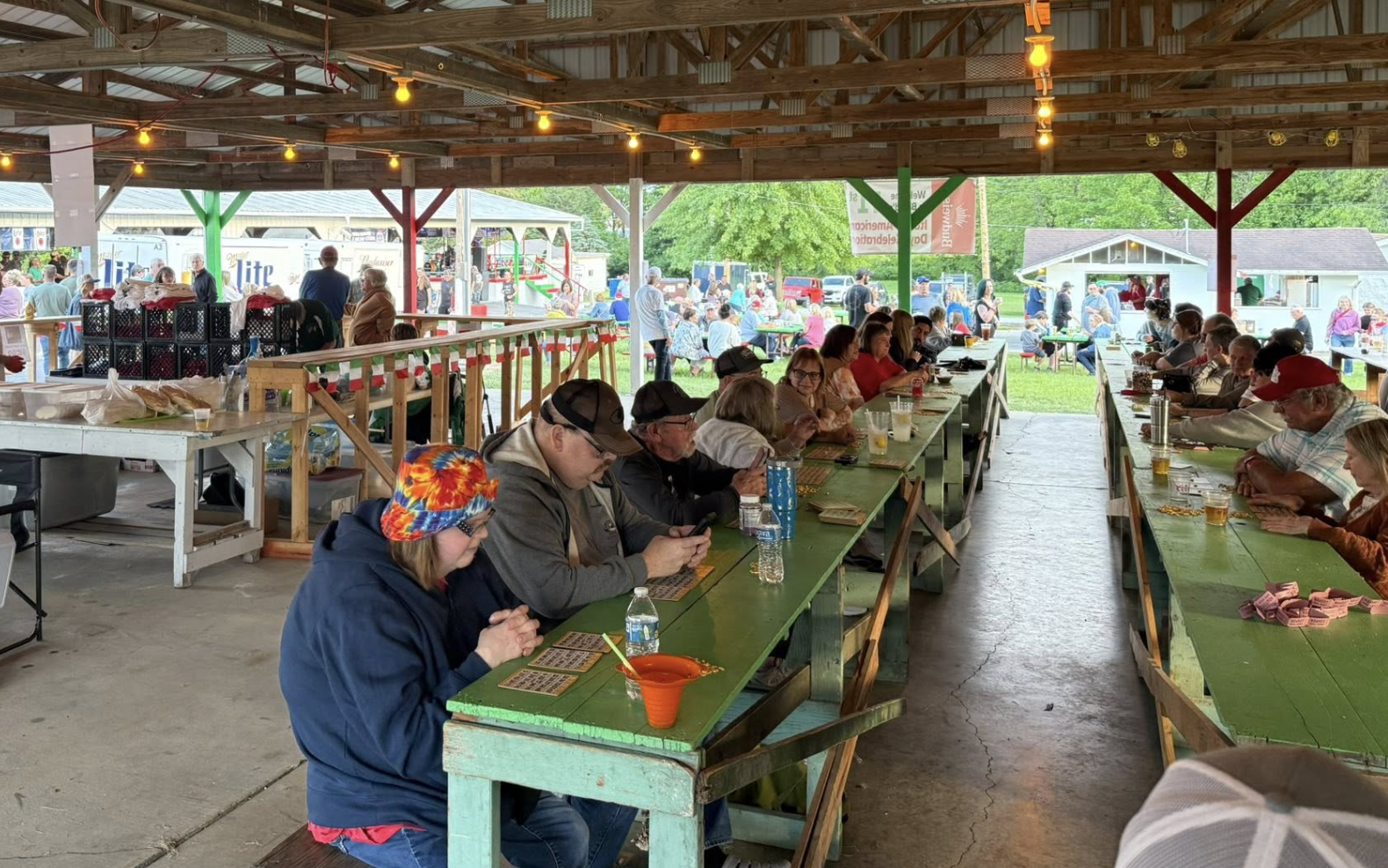
A beloved community tradition returns this Memorial Day weekend as the 72nd Annual Benld Italian-American Days brings three days of food, music, and family fun to Benld City Park from Friday, May 22 through Sunday, May 24.
Hosted by the Italian Club of Benld, the long-running festival celebrates the area’s rich Italian heritage while welcoming visitors from across the region for a full slate of activities.
Festivalgoers can expect a wide variety of homemade Italian favorites served throughout the weekend, including salami and meatball sandwiches, tortellini soup, bagna cauda, and cannoli. A daily fish fry featuring cod and whiting will also be available, along with classic festival fare such as hamburgers, hot dogs, Italian beef, and carnival treats. Beer, wine, and soda will be available for purchase.
In addition to the food, the event will feature carnival rides provided by Conner Family Amusement, Inc., with unlimited ride sessions offered throughout the weekend. Bingo will be held nightly at 7:00 p.m., and festival-themed shirts will be available for purchase.
Live music and dancing will take center stage each evening. Friday night entertainment includes a performance by Flip the Frog from 6:30 to 10:30 p.m., with the park open from 4:00 to 11:00 p.m.
Saturday highlights include the Italian Club Car Show, with registration from 8:00 a.m. to noon and judging beginning at noon. The park opens at 11:00 a.m., and live music will feature Pat Jones in the afternoon followed by Borderline in the evening.
Sunday kicks off with the “Meatballs on the Run” 5K at 9:00 a.m., sponsored by the Gillespie Cross Country Boosters. You can sign-up to participate online here. The day continues with free spaghetti served from 11:00 a.m. to 1:30 p.m., a bocce ball tournament beginning at noon, and a full lineup of live music throughout the day, including performances by Unbroken, Syner-Gee, and B&B Strings.
Connors Family Amusements will provide carnival armbands for $30. Armbands will be valid Friday (May 22) from 6:00 to 10 :00 p.m. and again on Saturday (May 23rd) and Sunday (May 24th) from 12:00 to 4:00 p.m. and again from 6:00 to 10:00 p.m, Advanced armband sales will be available from May 4th through May 21st at the Frank Bertetti Public Library and Benld City Hall for $25. Debit and Credit Cards will NOT be accepted.
Organizers note that no outside beverages are permitted in the park or at club events.
With its mix of tradition, entertainment, and community spirit, the 72nd Annual Benld Italian-American Days promises to once again be a highlight of the summer season in Macoupin County. For more information and updates, follow the festival on Facebook at Benld Italian American Days.
Comments

Gillespie will host a Community Blood Drive with ImpactLife, the provider of blood components for local hospitals. The blood drive will be from 1:00 pm to 6:00 pm on Monday, May 11 at 900 Broadway, inside Gillespie Methodist Church Gym.
To donate, please contact Brenda Lowe at (217) 7101336 or visit www.bloodcenter.org and use code 60020 to locate the drive. Appointments are requested. You may also call ImpactLife at 800-747-5401 to schedule.
Potential donors must be at least 17 years of age (16 with parental permission form available
through www.bloodcenter.org) and weigh more than 110 pounds. A photo I.D. is required to donate.
For questions about eligibility, please call ImpactLife at (800) 7475401. Donors who last gave blood on or before March 16, 2026, are eligible to give at this drive.
Blood donation is a safe, simple procedure that takes about 45 minutes to one hour. Individuals with diabetes or controlled high blood pressure may be accepted as eligible donors.
ImpactLife is a nonprofit community organization providing blood products and services to more than 100 hospitals and emergency medical service providers in Illinois, Iowa, Missouri, and Wisconsin, as well as researchers and resource sharing partners across the country.