

Community News
Gillespie Council weighs fate of Canna Theater



The Gillespie City Council on Tuesday night approved an ordinance authorizing a sewer rate hike and heard a presentation on city finances from City Treasurer Dan Fisher. But it was a lengthy discussion regarding the Canna Theater that took center stage during the council’s regular monthly meeting. The meeting was scheduled for Tuesday because of the Columbus Day holiday on Monday.
Ultimately no action was taken on accepting the Assembly of God Church’s offer to donate the building to the city, but Mayor John Hicks appointed Ald. Wendy Rolando and Ald. Larry Greene to meet with Jim Allan of Gillespie and report back to a committee meeting in two weeks. Allan is spearheading a loosely organized group advocating for the preservation of the aging structure. Allan’s vision involves the city taking possession of the building and either leasing or transferring ownership to his group with a goal of rehabbing the building as a performance venue.
City Attorney Dan O’Brien said the proposal could be problematic from a legal standpoint because of state laws regarding the acquisition of properties by municipal governments.
“If the city takes any property, it has to be for a public purpose,” O’Brien said. “It has to be for the citizens of Gillespie. If you take it in order to transfer it to a third party, that becomes more problematic.” O’Brien said “public purpose” can be broadly defined but generally would mean acquiring property for a parking lot or some other public purpose. Transferring the property to a third party, even a non-profit organization, could be done but would require a stretch of the “public purpose” definition, according to O’Brien.
O’Brien said a simple solution would be for the church to transfer it directly to Allan’s group. City Treasurer Fisher, however, indicated there would be some advantages to having the city act as the middle entity. Having the facility is owned by the city, he noted, would increase eligibility for grant funds. Moreover, for some grant programs, government entities may be eligible for twice as much money as a private entity. “If you need $200,000, the city might be able to get the whole amount,” Fisher said, “while a private group would only get half that.”
Fisher also noted that if Tax Increment Financing funds were used the city could authorize any amount for improvements if it owned the building. If it was privately owned, however, it would only be eligible for the amount the property had previously paid into the fund.
Fisher said he was impressed by the coalition Allan has put together. He said he fielded a phone call earlier from a supporter of the project from Chicago who had done some research and compiled a list of more than 30 potential sources for grant funds.

“I would argue that if you have an alliance involving the city, a church and a non-profit, that’s kind of the holy trinity for grants,” Fisher said.
Another advantage of city ownership, according to Fisher, would be facilitating demolition if Allan’s project fails to bear fruit.
“If our fall back is to tear it down, then we’d have to own it,” Fisher said.
The potential for the city owning the building and allowing someone else to administer it is not unprecedented, Fisher told the council. Welfare Park, for example, was transferred to the city to facilitate eligibility for a Department of Natural Resources grant. The Canna itself “has been in and out of public or semi-public ownership” for many years, Fisher said.
The city’s original intent was to acquire the building in order to demolish it as a public nuisance. In recent years, the building has fallen into disrepair. Deterioration of the roof, in particular, has allowed water to enter the building, causing extensive damage.
Staunton architect Dennis Schuete said the building is sound enough to be salvaged. The main issue, he said, is the roof, which could be secured at a cost of about $15,000—compared with the $62,000 it would cost to raze the building and remove the debris.
Schuete developed a list of materials that would be needed to rehabilitate the building. The checklist includes the roof, restoration of the block walls, repair of a rotted wooden floor backstage and other items. In total, the tab for materials would come to more than $100,000.
The project’s cost, however, could be significantly reduced with the donation of materials and labor.
Without donated materials and labor, Schuete estimated the tab for restoration would come to $500,000. But he put the value of the rehabilitated property at $2 million.
“I’m just one voice interested in seeing this building preserved,” Schuete said. He said he is heartened when he sees projects like the Illinois Coal Mining Museum, adding the project is feasible “if people work together and volunteer labor and materials.”
Community Fire District Chief Larry Norville, however, said he was asked to look at the building and give his opinion of its status.
“I’m not a structural engineer,” Norville said. “At this point, I think the building is a terrible liability to whoever owns it. If that building caught fire tonight, I would not send firefighters into it.”
Termite damage and rot, he said, have rendered the floor joist unsalvageable. All wiring would need to be removed and replaced. Norville said they used the Fire District’s snorkel truck to get a look at the roof, where it was noted the side walls are bowed, indicating they’ve separated from the rest of the structure.
Allan disputed Norville’s report, saying the roof is supported by steel beams and the remainder of the building is salvageable. Asked how he expected to raise money for the project, Allan listed several well-known musicians associated with Nashville or St. Louis bands who would be willing to perform benefit concerts.

“We want the city to be involved,” Allan said, “but if the city refuses, the church will turn it over to us.” He said his group is in the process of establishing a non-profit group to helm the project. Upon completion, he said the building would be a performing arts center available to the school district and other performers.
Ald. Frank Barrett suggested a residential apartment on the second floor could be rented out to help generate funds.
“We don’t want anyone living in it,” Allan stated, adding the apartment space might be used for music lessons or as an art gallery.
Although a final decision will not be made until Rolando and Greene report back to the full council, some aldermen expressed reticence about moving forward with the project.
“It’s going to take money to fix it and I do not believe it would be money well spent,” said Ald. Landon Pettit.
“How can we justify this when there are so many other things that need to be done in this town?” Ald. Bob Fritz asked.
“I’d want to see the bottom dollar before I vote for it,” said Ald. Rick Fulton. “What is it going to cost the city?”
FINANCIAL REPORT
City Treasurer Fisher provided a brief overview of the city’s income versus expenditures, and how he determines which funds to use for certain bills and the importance of structuring expenditures for efficiency.
“We have to figure out how to do more with less,” Fisher said. “It’s not just how we pay for things but when we pay for it and how we pay for it.”
Fisher said the city “operates in the red more months than we operate in the black,” in part because of fluctuations in income. The city receives relatively large influxes of cash in January and March, followed by October and April. For those months, along with August, the city ended the month in the black. For the rest of the year, however, the city ended each month with a deficit.
Fisher said he also faces restrictions on how certain funds can be used. Of the $3,023,832 cash on hand at the end of September, less than half was available for expenditures other than salaries. The percentage of funds available for non-salary expenditures varies by fund. Out of $284,485 in the General Fund account, for example, all but about $5,000 was committed to salaries. Other funds, including water and sewer, are slightly more flexible with seven to 15 percent of monies earmarked for salaries.
Over the course of the past 12 months, according to a graph presented by Fisher, the deficits at the end of seven months varied from $3,297 to as much as $95,305. Those deficits were somewhat offset by positive balances ranging from $7,600 to $157,300 at the end of five months. Still, at the end of September, the city was running $14,500 in the red.
With such tight financial constraints, Fisher said the city has to be careful about when and how it spends. “It’s not that we don’t have the money but we have to look at which funds we can pay those expenses from,” Fisher said. “The lake made a $4,000 profit last year. You can’t buy a truck for $4,000 so when we buy a truck for the lake, it gets split up among several funds.”
Comparing Gillespie’s financial picture with those of neighboring communities reveals that Gillespie has more limited resources for hiring police officers, according to Fisher. Consequently, the city has to be creative with its expenditures in order to compete with other cities when it comes to hiring new officers.
“When you guys ask me if we can afford something, my answer usually is ‘it depends’,” Fisher said. “If you don’t structure it the right way, the answer is ’no.’ If you structure it the right way, the answer can be ‘yes.’ It all fits into a big jigsaw puzzle. It depends on how it’s structured and how it fits in with the rest of the obligations we know we’re going to have.”
Fisher’s explanation of financial structuring came to the forefront when the council voted 6-2 to approve the purchase of a four-door diesel pick-up truck with a snowplow at a cost of $57,997. Ald. Pettit said the city had an option to buy a Ford F450 dump truck for $63,000 with no plow for $63,000 to replace a Chevrolet pick-up at the Street Department and shift an existing dump truck to the Lake Department.
“I think we’d be crazy not to do that and move the existing truck to the Lake Department,” Pettit said.
“We have a way we could buy that truck,” Fisher reported. “But if we do that, it would probably be the last piece of equipment we’re able to buy for a while.”
After more discussion, Pettit agreed with a proposal to buy the four-door pick-up for the Street Department and ship an existing dump truck to the Lake Department with the understanding it would come back to the Street Department during the winter months. His motion to buy the vehicle from Victory Lane Ford was seconded by Ald. Fritz and was approved with Ald. Rolando and Ald. Donna Rauzi both voting against the purchase.
Fisher’s presentation was further illustrated when he responded to a question from visitor Dave Link who wanted to know why the city allowed a sizable surplus build-up in the Motor Fuel Tax Fund when there are many streets in need of attention.
Fisher said the city anticipates a major storm and sanitary sewer project within the next 15 months. While MFT funds cannot be used for sanitary sewers, they can be used for storm sewers.
“We anticipate we’re going to need half a million dollars or $650,000 to pay our share of those projects,” Fisher said. For that reason, the council approved relatively modest MFT street maintenance programs in recent years, allowing surplus money to build up in the fund. What wasn’t anticipated, he said, was a substantial increase in MFT distributions from the state this year. As a result, he predicted the next MFT maintenance program will be $210,000 to $220,000 and include more streets than in recent years.
LABOR ISSUE
Link also questioned why Street Department employees have not had a contract since Dec. 31. Link said his understanding was that the sticking point was a one-time $1,500 longevity bonus.
“I’m sure your attorney costs you more than $1,500 for four guys,” Link said, referring to the continuing negotiations.
“It’s not that we’re denying them their money,” said Mayor Hicks, “we’re just trying to get the contract settled.” Before City Attorney O’Brien advised against negotiating contract issues in a public meeting, Hicks said his understanding was that the four Street Department employees were in favor of the contract proposal. It was unclear, however, what position other employees covered by the contract had taken.
SEWER RATE HIKE
Council members voted unanimously to approve an ordinance to increase consumer sewer rates by $3.50 per 1,000 gallons of usage. The new rate will be effective with the next billing cycle.
Increasing the rate has been under discussion since August when City Treasurer Fisher recommended increasing the rate to ensure eligibility for sewer improvement grants.
TREE REMOVAL
In other action, the council approved a contract with Niehaus Tree Service to remove a dead tree at Pine and Second streets and three dead trees at the Gillespie Lake campground at a total cost of $550.
Aldermen also approved a resolution to release Tax Increment Finance funds to pay for a new metal roof on the Police Department building.
Comments













Ye Olde Christmas is the theme of the Macoupin County Historical Society’s annual Christmas Show, which will be held Friday through Sunday, December 5–7, at the John C. Anderson Home and Museum, 920 West Breckenridge in Carlinville.
“The Christmas Show is one of the most magical times to visit the Anderson Home,” said MCHS Board Member and House Manager Brandy England. “Some families make it an annual Christmas tradition to visit the Anderson Home when it is decorated for Christmas. It’s a great opportunity to get into the Christmas spirit and pick up some ideas for decorating your own home for the holidays.”
MCHS member Kendra Mize, of Bunker Hill, who has coordinated the decorating effort for more than two decades, has again marshalled a small army of volunteers to decorate all 13 rooms of the home. Each room features a themed Christmas tree, along with mantle pieces, centerpieces, tabletop decor, garlands and florals, and other special touches.
The home will be open for self-guided tours from 4 p.m. to 9 p.m. on Friday, December 5; from 9 a.m. to 9 p.m. on Saturday, December 6; and from 10 a.m. to 3 p.m. on Sunday, December 7.
“We’re very excited to offer for the first time candlelight tours from 6 p.m. to 9 p.m. on Friday and Saturday,” said Shawna Ashby, who serves as a co-manager with England. “Viewing the decorated home by candlelight promises to be a magical experience.”
The final candlelight tours on Friday and Saturday start at 7:30 p.m. Admission to the home is five dollars for adults and one dollar for children ages five to 12, with four-year-olds and younger admitted free of charge.
The Anderson Home Gift Shop will be open during tour hours, offering one-of-a-kind gift items and stocking stuffers. Santa Claus will be on hand in the downstairs parlor to greet children and listen to their Christmas wishes from 1 p.m. to 4 p.m. on Saturday, December 6.
While the decorated home is the centerpiece of the Christmas Show, several other features on the Historical Society’s grounds will be open. The Red Barn will be open and serving hearty beef stew, chili, homemade pies, and warming holiday beverages such as wassail and hot chocolate on Friday and Saturday.
The General Store and Print Shop will be decorated and open to the public, with the Print Shop offering its popular handmade Christmas cards and other items produced in the shop; kids can print their own blank “Santa List” to keep track of their Christmas wishes.
“The General Store offers unique gift items, including some small antiques, for shoppers to peruse,” England noted.
Local blacksmiths will demonstrate their craft in the MCHS Blacksmith Shop located on the north side of the Historical Society Grounds, with wrought iron gift items, including stocking hooks and decorative pieces, available for purchase.
The Macoupin County Historical Society’s Christmas Show runs concurrently with the Carlinville Christmas Market and Downtown Christmas events, and a free trolley and shuttle buses include the Anderson Home as a regular stop during the festivals, enabling visitors to ride from the square or the Macoupin County Fairgrounds to the Historical Society grounds.
Comments
Members of the Community Unit School District 7 Board of Education on Monday night voted to approve a property tax levy request totaling $3,920,295 for 2025 property taxes payable in 2026. Because of tax caps and other factors, however, the district expects to collect only an estimated $3,786,607 of the requested amount.
In addition to acting on the tax levy, the board also held a lengthy discussion regarding annual district “report cards” issued by the Illinois State Board of Education to assess school performance from last year, approved a high school band/choir performance trip to Chicago in March, and agreed to apply for a school maintenance grant of up to $50,000 in matching funds.
The new proposed levy exceeds last year’s tax extension of $3,599,569 by more than $320,726—an increase of about nine percent if the levy were to be approved at the county level. The more realistic anticipation of $3,786,607 exceeds last year’s extension by $187,038, or an increase of about three percent. A Property Tax Extension Limitation Law (PTELL), approved by Macoupin County voters in 1995, restricts increases in the levy to five percent or the federal Consumer Price Index (CPI), whichever is less. This year’s CPI is estimated at 2.9 percent.
The approved levy seeks $1,650,000 for the Education Fund while expecting to realize $1,653,831; $450,229 for Operations & Maintenance, while anticipating $438,041; $200,000 for Transportation while expecting $180,434; $35,000 for Working Cash while expecting $42,602; $174,700 for the Illinois Municipal Retirement Fund while anticipating $117,788; $154,101 for Social Security while expecting $105, 248; $247,264 for Tort while anticipating $240,570; and $33,501 for Special Education while expecting $32,593. For Bond and Interest, which is not subject to PTELL, the district is levying $975,500 while anticipating the same amount.
Local property tax revenue accounts for about 20 percent of the district’s overall annual budget.
Because the levy request exceeds 105 percent of the previous year’s extension, a public hearing is required. That hearing is scheduled at the start of the board’s regular December meeting at 6 p.m., Monday, Dec. 15. In the meantime, the proposed levy is available for public inspection on the district’s website and in the district office.
Using a PowerPoint presentation, Owsley emphasized the levy request is essentially a wish list for what the district would like to raise through property taxes.
“The levy is the ‘Christmas list’ I talk about every year,” Owsley said. “If you don’t put it on the list, you’re not going to get it.”
Projecting what the district can legally seek under tax caps can be challenging because the district’s total equalized assessed valuation will not be confirmed until after Jan. 1 while state law requires the district to file its levy request before the end of December. For that reason, local school districts routinely file requests that exceed what they actually expect to receive in property tax revenue, and rely on the County Clerk to adjust the request to the maximum amount the district can receive.
“Because of tax caps, we have one shot to capture increases in the EAV and new construction,” Owsley said. “If we don’t do that, we lose it in perpetuity.”
To calculate the new levy, Owsley projected a 15.12 percent increase in the EAV—nearly double the previous year’s rate of increase. By overestimating the EAV growth, the district expects to capture the entire increase in assessed valuation when that number is finally determined.
“Even though we know the EAV will likely be around the historical average, we base our levy on a much higher amount so as not to lose revenue from new growth,” Owsley told the board. “We can do this without running the risk of overtaxing taxpayers because the district will receive no more than what we are entitled to by law.”
Owsley said relatively stable increases in EAV have resulted in a steadily declining tax rate. Since 2014 when the rate was $4.24 per $100 in EAV, the rate has fallen to $3.20 for 2024. In other words, the county can use a lower rate to generate the extension to which the district is entitled because the value of taxable property has increased.
“As long as the EAV goes up by more than the Consumer Price Index, our tax rates are going to go down,” Owsley noted.
SCHOOL DISTRICT REPORT CARDS
The board spent several minutes discussing recently released school report cards issued by the Illinois State Board of Education. Interested persons can view local report cards by visiting https://www.illinoisreportcard.com/.
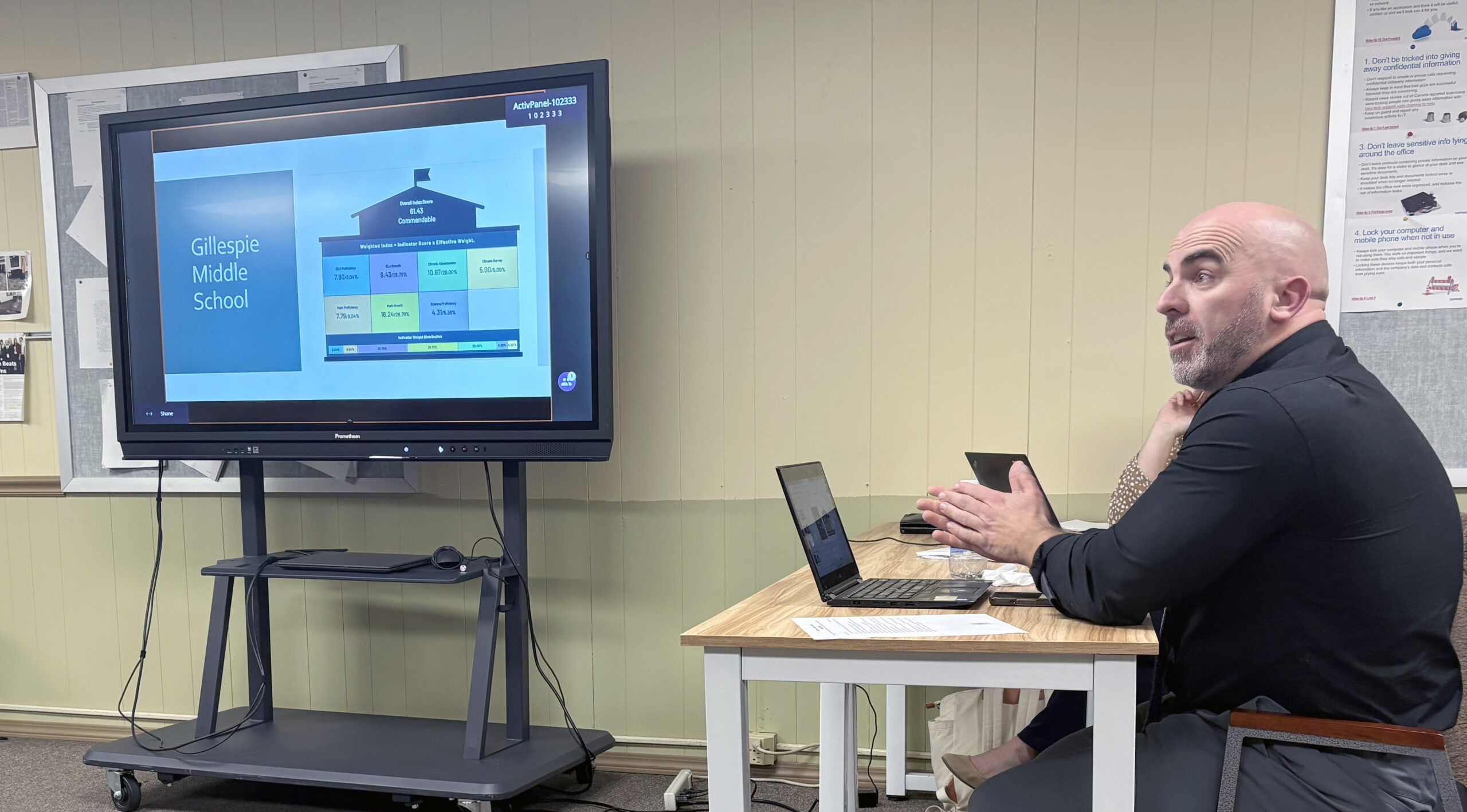
All three attendance centers received a “Commendable” designation, meaning there are no student groups that are underperforming academically, and the high school graduation rate exceeds 67 percent. Last year, BenGil Elementary School achieved an “Exemplary” designation—the top designation a school can achieve.
Elementary Principal Angela Sandretto said administrators knew the school would not earn an Exemplary rating, even though students are state average in English/language arts, math and science. The Report Card designations are based on growth rather than academic performance. With students already exceeding state standards last year, the opportunity for growth was limited.
Assistant Principal Tara Cooper agreed, noting BenGil Elementary’s student performance is in the upper half of schools statewide that are meeting academic standards. “So, while we are not ‘Exemplary,’ we’re very happy with where we are.”
Supt. Owsley told the board the State Board of Education is working on revamping the assessment system because of the growth vs. performance issue. “That’s why they’re redoing all of this because they are penalizing schools for meeting goals,” he said.
For Gillespie Middle School, the report card shows students meeting or exceeding state averages in math and science but significantly lagging in English/language arts.
“ELA is our most concerning area,” Principal Patrick McGinthy told the board, “along with absenteeism.” The report card shows a chronic absenteeism rate of 25 percent, but Owsley and other administrators said the rate is exacerbated by the State Board of Education including nearly all absences whether or not they are excused.
Rosentreter noted the State Board will allow a student to be absent five days for illness without a doctor’s excuse. On the sixth day, however, the absence is unexcused unless the parent or guardian provides a doctor’s slip. Many parents, however, are reluctant to pay for a doctor’s visit for a child that is suffering from a minor illness.
McGinthy said Middle School teachers are attempting to address the deficiency in English/language arts by increasing writing exercises and requiring students to write in conjunction with other curriculum areas.
Rosentreter noted that the assessment standards for high schools differ from the standards for elementary and middle schools in that the State Board emphasizes graduation rates. For Gillespie, the graduation rate is an impressive 86 percent, though chronic absenteeism checks in at 31 percent.
“Math is definitely our shining star,” Rosentreter said, noting the school scored 17.8 points compared with the state average of 18. The school performed less well in the areas of English/language arts and science, scoring 16 points on ELA compared with the state score of 18 and 17.2 points compared with the state average of 19.
The report cards are based on results for the Illinois Assessment of Readiness (IAR) test for elementary and middle school students, and ACT scores for high school students.
Administrators said it’s difficult to motivate students to do well on state-mandated tests since the tests do not affect the student’s grade point average. To incentivize testing, Rosentreter said the high school is offering to let students skip final exams if they hit state standards on the mandated tests.
Owsley noted that the district report card documents the continuing decline in school enrollment—dropping from 1,325 seven years ago to 1,082 for the 2024-25 academic year.
“We don’t see that turning around anytime soon,” Owsley said. “It’s not just a Gillespie thing; it’s a trend for schools throughout Macoupin County.
BAND/CHOIR TRIP TO CHICAGO
Following a presentation by band/choir instructor Brad Taulbee, the board approved a high school band and choir performance tour to Chicago set for March 19-21. Taulbee said the tour company retained for the trip places emphasis on security and safety for traveling students. The company supplements hotel security with its own security personnel to monitor student rooms during the trip.
The tour includes workshop sessions at Vandercook College in downtown Chicago, and performances by the choir at the John Hancock Center and by the band at one of the city’s museums.
Taulbee said he is attempting to keep the cost affordable for participating students. Depending upon the number of students who ultimately go on the trip, he said he expects the cost to be about $739 per person. Additionally, he is lining up sponsors who can help with expenses for students who could not otherwise afford to participate.
“Security is my main concern,” said Board President Mark Hayes. “We just came back from there and seven people were shot in the area we were in.”
Taulbee said he expects to recruit seven to 10 chaperones and will ensure that the ratio of students to chaperones does not exceed 1:10.
SCHOOL MAINTENANCE GRANT
The board concurred with Supt. Owsley’s recommendation to again apply for a state School Maintenance grant of up to $50,000. The grant is a “matching” grant requiring the district to match grant funds dollar for dollar. The district has successfully applied for the grant for the past several years.
If the application is successful, Owsley said the funds will likely be used to remove asbestos-containing floor tiles in the choir room and elsewhere in the Middle School.
PERSONNEL
Following an executive session of about 40 minutes to discuss personnel and other issues, the board voted unanimously to accept the resignation of Tim Wargo as an assistant high school baseball coach and post the position as vacant, and voted to appoint Wargo as the head high school baseball coach for the coming season.
In separate actions, the board approved maternity leaves for Alexis Lupkey, district paraprofessional, and Gear-Up Coordinator Jordan Bartok. Lupkey’s leave is tentatively scheduled from Dec. 8 through March 18. Bartok’s leave is expected from Dec. 12 through Jan.6.
Board members voted unanimously to hire Christopher Whaley as a substitute bus driver, pending a routine background check and documentation of certification.
The board also voted unanimously to terminate Makayla Huff as a three-hour cook and post the position as vacant.

On a motion by Bill Carter, seconded by Weye Schmidt, the board voted unanimously to rehire fall coaches as follows: Jordan Bartok as head high school girls volleyball coach with Shelsie Price, as an assistant coach; Cory Bonstead as head football coach with Nate Henrichs, Jarrod Herron, Korben Clark, Alex Jasper, J.O. Kelly, Billy Gill and Florian Seferi as assistant and volunteer assistant coaches; Jay Weber as head coach for the parent-funded high school cross-country program with Jack Burns as a volunteer assistant coach; Jake Kellebrew as head coach for the parent-funded high school golf program, with Michael Otten as a volunteer assistant coach; Tim Wargo as head middle school baseball coach with Trae Wargo as assistant coach; Michelle Smith as head middle school softball coach with Jim Matesa, Joe Kelly and Melissa Heigert as assistant coaches; and Liz Thackery as head coach for the parent-funded middle school cross-country program with Laura Peterson as a volunteer assistant coach.
DISTRICT FOCUS
During a District Focus segment, Supt. Owsley introduced newly hired School Resource Officer Jacob Linhart, and High School Principal provided a report with photos of a recent school-wide Veterans Day observance.
Linhart, who has served five years as a police officer on the Gillespie Police Department, replaces Wade Hendricks, who recently retired after serving three years as the CUSD 7 School Resource Officer.
Linhart said it is a “great privilege” to serve as a Resource Officer, protecting students and staff. “I’m honored that you guys are allowing me to do it,” he said.
High School Principal Rosentreter said the school served breakfast to about 200 veterans and their families Tuesday morning, Nov. 11. Later, the veterans were joined by nearly 700 high school and middle school students for a recognition ceremony in the high school gymnasium.
Since the event coincided with the 25th anniversary of CUSD 7’s Wall of Honor program, the annual event did double duty as an induction ceremony for five are individuals, all of whom happened to be U.S. Military veterans.
The inductees included the late Sergeant Major John Marion Malnar, Command Sergeant Major John “Jack” Burns, Colonel Mark Daley, Lieutenant Colonel William P. Falke and Captain Robert Leone. Rosentreter said Daley and Leone traveled with their families from Colorado and Texas, respectively, to attend the ceremonies.
Burns, a retired CUSD 7 teacher, later visited BenGil Elementary School to present a program and teach students how to properly fold an American flag.
Rosentreter recognized the City of Gillespie for a donation of $1,000 to help purchase food for the veterans.
Born in Benld and a resident of Sawyerville, “Big John” Malnar earned a Silver Star during the Korean Conflict and a Gold Star, awarded posthumously after he was killed in action in 1968 in Vietnam. A Marine training center at Camp Geiger in North Carolina is named in his honor.
Though not a Wall of Honor inductee, Jacob Miller, a 100-year-old World War II veteran and recipient of two Purple Hearts, was recognized with a standing ovation.
The annual Veterans Day breakfast and ceremony provides students with an opportunity to meet and recognize local veterans as potential role models for their own futures.
Owsley said the event is a major event on the district’s calendar which grew out of a simple flagpole ceremony initiated 25 years ago.
CEJA GRANT FUNDS
Board members briefly discussed plans for about $74,000 in anticipated Climate and Equitable Jobs Act (CEJA) grant funds. The federal program is intended to compensate communities that have experienced revenue loss as a result of coal mine closures.
Owsley said the district committed about $86,000 in last year’s CEJA grant funds to the City of Gillespie to help pay for improvements to Plum Street, which is heavily used by district school buses. He has not transferred those funds, however, pending the start of the project.
Owsley said he was seeking the board’s input on how the money should be used.
“We could continue to partner with the city on Plum Street,” he said. “But there are plenty of project areas within the school.” The money could be used, for example, for continuing asbestos abatement. He identified other upcoming needs, including a new roof for the high school/middle school and an HVAC project.
President Hayes pointed out the school district paid for improvements to Kelly Street when BenGil Elementary was built and subsidized a project to reconfigure drainage on Broadway Street, in addition to the dollars committed for Plum Street.
“The school district is not in the business of building roads,” he said. “I think we’ve been more than generous with the city.”
Board member Peyton Bernot agreed the money should be committed for use by the school district.
TRIPLE I CONFERENCE
Several board members who attended a conference for board members and administrators Friday-Saturday, Nov. 21-23, in Chicago, commented briefly about their take-aways from conference sessions. Popularly known as the Triple I Conference, the convention is sponsored by the Illinois Association of School Boards, Illinois Association of School Administrators and the Illinois Association of School Business Officials.
Owsley said more than 700 Illinois school districts were represented, making the Triple I the largest gathering of education professionals in North America.
Bernot briefly reported on a session he attended regarding upcoming legislation and financial outlooks for school districts. He described the session as “much less optimistic” than sessions he’s attended in the past.
Owsley was among the convention presenters, discussing social-emotional learning. He commented that several districts attending reported efforts to involve students in school administrators. Some districts, he said, appointed a non-voting student representative to the school board to take part in discussions directly affecting students.
“When you think about it, we hear from faculty members and we hear from parents,” Hayes commented. “The people we don’t hear from are the most important part of what we do.”
Comments

The Holiday Sparkle Committee of Gillespie is preparing for the 4th Annual Holiday Sparkle Lighted Parade and Community Tree Lighting, set for Sunday, November 30, at 6:00 p.m. in downtown Gillespie. This beloved community tradition invites residents and visitors to kick off the holiday season with lights, music, and festive cheer.
Food trucks will line the parade route starting at 4:00 p.m., offering a variety of tasty options for families to enjoy before and during the celebration. The event will culminate in the illuminated parade and the ceremonial lighting of the community tree, signaling the official start of the season’s celebrations.
A highlight of this year’s festivities will be a special performance by Gillespie area students in grades 3 through 5. The group will join together to sing Christmas carols, lending their voices to the town’s joyous welcome to the holidays.
Parade participants are invited to bring extra sparkle to the evening—whether by entering a parade float, walking in the parade, or simply attending to enjoy the atmosphere. Participation helps make the event truly magical for the entire community. The only requirement for the parade is all entries have to incorporate holiday lighting.
To join the parade lineup, interested participants can sign up at https://forms.gle/L7Q4tEkgjj8Lt5E47. The Holiday Sparkle Committee expresses gratitude for the ongoing support of residents, businesses, and volunteers who help bring this festive occasion to life each year.
The second part of the holiday festivities will take place on Saturday, December 13 when the Sparkle will sponsor the vendor fair and food trucks in downtown Gillespie including a visit from Santa. Vendors will be located in the Gillespie Civic Center, Zion Lutheran Church, and Emma G’s Upscale Boutique while local businesses and eateries will also be open. An egg nog jog benefitting Gillespie Cross Country will also be held on December 13 and interested participants can join here.
The Holiday Sparkle Committee invites everyone to mark their calendars and join in the celebration. For more information, please contact the committee by email at gillespieholidaysparkle@gmail.com or visit Gillespie Holiday Sparkle on Facebook.


