Community News
School board approves $19 million budget, seeks exemption from publishing report

Members of the Community Unit School District 7 Board of Education on Monday night voted to approve an $19 million budget for fiscal 2026, agreed to seek an exemption from publishing an annual statement of affairs, and approved the sale and/or trade of three district-owned properties in Gillespie.
Approval of the budget followed a 30-minute public hearing during which Supt. Shane Owsley discussed details of the document that will govern spending for the current fiscal year. Though the hearing is required by law, no members of the public attended the hearing. The proposed budget had been on file for 30 days for public review prior to Monday night’s regular monthly meeting of the board.
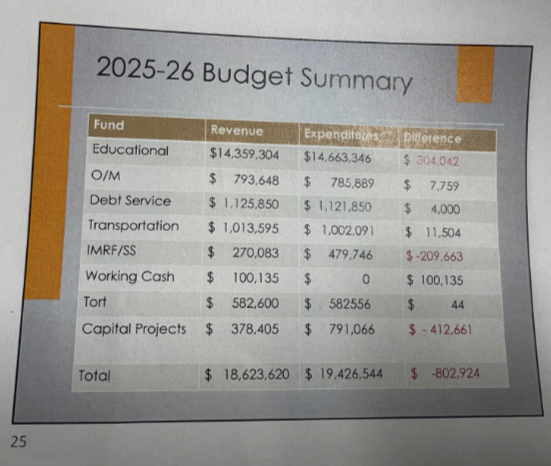
The budget projects anticipated expenditures of $19,426,544 for the fiscal year that began July first, against estimated revenue of $18,623.620. With those numbers, the district would expect a deficit at the end of the fiscal year of $802,924. However, Owsley explained, that deficit could be less or non-existent because he included up to one percent of the Education Fund and Transportation Fund for unexpected contingencies. Moreover, his revenue estimates are extremely conservative, projecting a decline of 1.45 percent from last year.
“As I emphasize every year, the budget is a plan,” Owsley told the board. “There are going to be things that come up. We probably will need to make adjustments at the end of the year. I do a cash flow analysis every month, and I will keep you updated throughout the year.”
For the Education Fund, the budget anticipates total revenue of $14,359,304. The lion’s share of that revenue is expected to come from state sources. More than $9.8 million of the Education Fund’s revenue is expected to come from state aid, representing 68 percent of the total. Local funding in the form of property taxes, book rentals, lunch fees, and other sources is expected to provide $2,381,840, or 17 percent of the total revenue, while $2,170,864 in federal funding will account for 15 percent of the Education Fund’s total revenue.
“Most of our money for Education comes from the state,” Owsley commented, adding that federal funding will be likely to decline in the future as COVID response programs such as Elementary and Secondary School Rescue (ESSR) expire.
The budget anticipates $14,663,346 in expenditures from the Education Fund, resulting in a $304,042 deficit. A total of $8,753,709 of the expenditures is allotted for Education, with $3,867,629 earmarked for Support Services and $1,854,841 tagged for payments to other school districts. A total of $120,000 is set aside for contingencies which would reduce the end-of-the-year deficit if not used.
The Transportation Fund is expected to receive $1,013,595 in revenue, with local funds covering 26 percent, or $258,595, of the total. State funds are expected to comprise the lion’s share of the funding at $755,000. However, a portion of the state’s share will come from Evidence Based Funding originally intended to support education costs.
Approved by the state legislature in 2017, Evidence Based Funding directed new state revenue to school districts that are farthest from achieving adequacy targets needed to pay for a quality education. While the law was intended to boost support for education services, Owsley said cuts in transportation funding are forcing school districts to commit some EBF funds to support transportation costs. He said the General Assembly is considering legislation to address the disparity in the future.
Simultaneously, the amount of EBF funds the district receives is declining, largely because the Gillespie School District has been moved from Tier I priority to Tier II, meaning it is coming closer to reacher the state-identified level of adequate funding for education.
“The good news is that we’re closer to being fully funded,” Owsley said. “The bad news is that it kicks us up from Tier I to Tier II.” As a result, EBF revenue is expected to drop from more than $300,000 last year to just $121,147 this fiscal year.
“That’s less than half of what we got last year,” Owsley said.
The new budget anticipates Transportation Fund expenditures of $1,002,091 for fiscal 2026. About 77 percent of those expenditures is earmarked for salaries and supplies, with 18 percent set aside for debt service. The budget sets asides .5 percent, or $50,000, for contingencies.
The Building Fund, which pays for operations and maintenance, is expected to receive $793,648 in revenue, with local funding covering 57 percent, or $456,759. Federal funding is expected to account for 25 percent while the state is expected to cover 18 percent. Expenditures from the Building Fund are expected to total $785,889, primarily for general maintenance, utilities, supplies and custodial services.
For Debt Service, the school district expects to receive evenue of $1,125,850 from the county School Facilities Sales Tax and expend an equal amount.
For Capital Projects, the district expects $375,405 in revenue from state and local sources but expects expenditures of $791,066, resulting in a deficit of $412,667.
The budget projects revenue of $270,083 in revenue for the Illinois Municipal Retirement Fund and Social Security. About 86 percent of that revenue will come from local sources, bolstered with an injection of $38,500 in EBF money. Anticipated expenditures of $479,746, will result in a deficit of $209,663 for the fund.
Revenue for the Tort Fund, primarily used for legal expenses, is expected to be $582,600 with projected expenditures of $582,556. If those numbers hold for the year, the Tort Fund will end the year $44 dollars in the black. Like the retirement fund, the Tort Fund’s revenue will come from local sources with the support of EBF money.
Working Cash, often described as a rainy day fund, is expected to get $100,135 in revenue from local sources. No expenditures are anticipated. When added to the current Working Cash Fund, the fund should end the year with a balance of $3,024,798.
Owsley said he plans to apply for a state Maintenance Grant of $50,000 which would mitigate against the deficit. He also pledged to apply for additional grants as they become available.

The budget compares revenue and expenditures by line item for the fiscal year. A truer picture of the district’s financial health lay in the fund balances. The total of all fund balances at the end of fiscal year 2025 was $15,920,564. At the end of the current fiscal year, that total is expected to drop to $15,117,640 as the district taps into reserves to meet its obligations. With $15 million in reserves against a $19 million budget, the district has about 80 percent of a year’s worth of operational costs.
Responding to a question from Amanda Ross, board member, Owsley said delays in property tax disbursements from the county have not had a significant impact on the district’s finances so far.
“We’re very fortunate to have reserves, so it hasn’t been issue for us over the past couple of years,” he said. “As reserves get spent down, it could be a problem if the delays continue.”
STATEMENT OF AFFAIRS WAIVER
The board also conducted a hearing on whether or not the district should apply for a waiver exempting the district from publishing an annual statement of affairs, ultimately authorizing the superintendent to apply for such a waiver.
State law previously required all school districts to publish a statement of affairs (basically a listing of salary ranges for all district staff and faculty) in a local newspaper. Recent legislation allows districts to apply for a five-year waiver exempting them from the requirement.
Owsley said publishing the report typically runs about $750 annually. A five year waiver would result in a savings of about $4,000.
If the waiver is granted, the district will post the annual report on its webpage.
PROPERTY SALES/TRADE
Following a 40-minute executive session to discuss personnel and real estate, the board voted unanimously to deed a district-owned lot on Park Avenue, Gillespie adjacent to Bear Creek to the City of Gillespie in exchange for city-owned parcel on the city’s northeast side that is adjacent to another parcel owned by the school. The transaction is subject to approval by the Gillespie City Council at a later date
The city reportedly has wanted to acquire the Park Avenue parcel to access Bear Creek for maintenance work without trespassing on private property.
The board also voted to sell two lots on the city’s northeast side located west of Illinois Route 4 to John Blank for $750 each, plus legal costs associated with the transaction. Board Member Dennis Tiburzi recused himself from the vote to preclude conflicts of interests due to his employment with the Macoupin County Public Health Department, which is directed by Blank’s wife.
All three parcels were declared surplus property several months ago.
SIXTH DAY ENROLLMENT
The board briefly discussed the district’s sixth day enrollment report which shows a continuing downward trend in enrollment.
Total district attendance has declined from 1,073 last year to 1,044 this year. Owsley provided an 11-year summary showing attendance has steadily declined from 1,325 students enrolled in 2015-16.
With 495 students, enrollment at Ben-Gil Elementary School is down from 498 last year and 645 in 2015-16. Middle School enrollment is down to 237 from 245 last year and 310 in 2015-16. High School enrollment is down to 312 from 330 a year ago and 370 in 2015-16.
Owsley said CUSD 7 is far from alone in dealing with declining enrollment.
“We’re at an all-time low for all three buildings,” he said. “Every single school in the county has seen decreases in enrollment. Every school in the South Central Conference is seeing declines.”
Owsley said CUSD 7’s enrollment decline rate is the third fastest in the county. He said administrators will be studying birth rates and other data to predict future potential declines in enrollment.
“The days of having 100 or more students in a class have definitely gone away,” he said.
Since state aid payments are based on enrollment, serious declines in enrollment can affect a district’s access to state revenue.
PERSONNEL
As result of executive session discussion, the board voted unanimously to hire Jeff Nehls as Gillespie High School head women’s track and field coach, and voted unanimously to hire Michael Otten as the freshmen men’s basketball coach.
On a motion by Bill Carter, seconded by Ross, the board voted unanimously to appoint Asia Washington as a volunteer high school cheerleading coach, pending confirmation of certification and a routine background check.
In separate actions, the board hired Ben Maddox as a full-route bus driver, and accepted the resignation of Quentin Heyen as a full-time bus driver. By a unanimous vote, the board hired Leah Maddox-Taylor as a substitute bus driver, pending confirmation of certification and a routine background check.
DISTRICT FOCUS
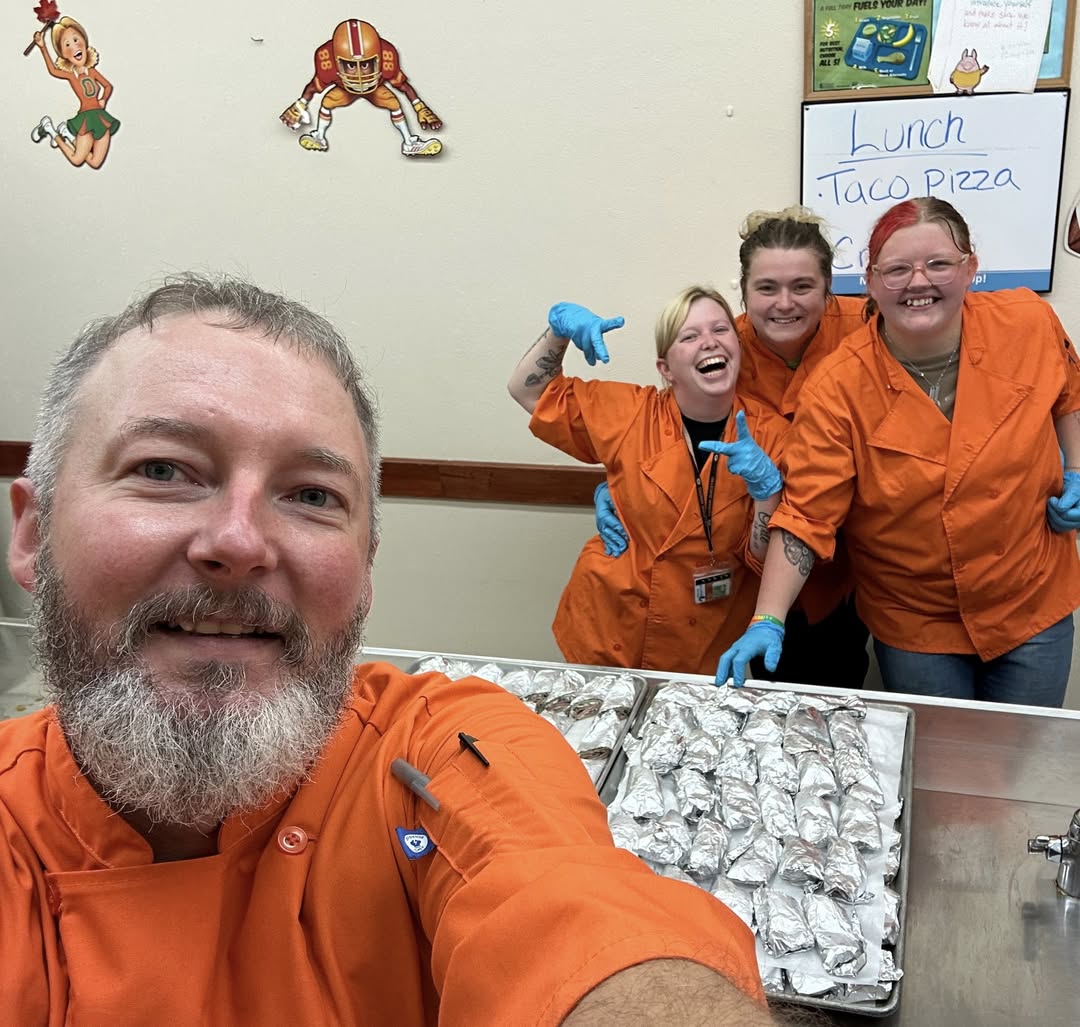
During a District Focus segment, Supt. Owsley introduced Chef Andy Hirstein, formerly of the Barracks restaurant, and the Gillespie High School/Middle School cafeteria staff. Hirstein was hired this year to oversee food service in the cafeteria.
“I cannot be happier with what’s going on in the high school/middle school cafeteria,” Owsley said. He read from a list of recent food options offered during the school lunch period, including John Wayne casserole, oven fried chicken, jambalaya, fruit smoothies, Hawaiian chicken wrap and other offerings. “We have a full-blown restaurant in our cafeteria now. We have meals that people would come in off the street and pay for.”
Owsley said Hirstein provided him with a report on the cost of food for the first month of school that was half of food costs for the same period last year. “Not only are we putting out an amazing spread, but are costs are down as well,” Owsley said.
Owsley said the number of students eating lunch on campus hit 300 last week. “For a school with an open campus at lunch, that’s incredible,” he said.
GHS Principal Jill Rosentreter said that apart from the quality of the food, Hirstein and staff have created a “great atmosphere.”
“There is laughter, there is camaraderie, there is respect, there is discussion,” she said. “It’s a completely changed environment.”
In addition to the food quality and atmosphere, GMS Principal Patrick McGinthy said the food presentation is superior.
Board member Kellie Vesper commented on Hirstein’s and staff’s uniforms, saying that contributed to the operation’s professionalism and commands respect from students.
Ross noted that the new emphasis on quality and variety is important because “some kids don’t get to go home to a warm meal at night.”
In addition to Hirstein, the cafeteria staff includes Amy Costello, Makayla Cunningham and Brittany Hughes.
PARTNERSHIP DONATION
Owsley publicly acknowledged a $30,000 grant from the Partnership for Educational Excellence to purchase personal computing devices for students. Over the past four years, the Partnership has donated a total of $120,000 to purchase computer devices for student use.
“We couldn’t do what we do without their generosity,” Owsley said.
Comments









FELONIES
Justine D. Pocklington, 27 of Standard City, possession of methamphetamine (<5 grams), aggravated feeling police/21 mph over, no valid registration, and operating an uninsured motor vehicle in connection with a February 2 incident.
MISDEMEANORS
Katlyn N. Pilger, 21 of Benld, is charged with theft/unauthorized control (<$500) in connection with a March 28 incident.
Donald L. Lloyd, 46 of Staunton, is charged with criminal trespass to land in connection with an April 5 incident.
TRAFFIC
Tarina S. Slaughter, 47 of Girard, is charged with improper use of registration/title, unlicensed, and operating an uninsured motor vehicle in connection with an April 4 incident.
William C. Geiser, 60 of Gillespie, is charged with reckless driving in connection with an April 6 incident.
Lauren E. Wolfe, 21 of Granite City, is charged with improper use of registration/title and expiration of registration in connection with an April 3 incident.
Jim T. Wahl, 53 of Cottage Hills, is charged with driving on a revoked license in connection with an April 8 incident.
DISSOLUTION OF MARRIAGE FILED
- Nora Washington versus Joseph D. Washington
- Samantha Lehnen versus Chad Wallace
MARRIAGE LICENSES
- Colton D. West of Hettick and Alina M. Carver of Scottville.
- Devin J. Martin and Mariah P. Crane, both of Bunker Hill.
- Jonathon E. Swisher of Shipman and Mackenzie P. Calvin of Saint Charles, MO.
- Lucas Boschelli and Danielle J. Boatman, both of Carlinville.
- Todd R. Leverton and Jennifer L. Bowman, both of Carlinville.
Comments

SUNDAY, APRIL 5, 2026
An officer was dispatched to the 500 block of North 7th Street in Benld in reference to a civil issue.
An officer was dispatched to the 400 block of West Oak Street in reference to a civil issue.
An officer was dispatched to the 300 block of East Oak Street in reference to harassment.
An officer was dispatched to the 200 block of South Main Street in Benld in reference to a civil standby.
An officer was dispatched to the 100 block of Park Avenue in reference to a 911 call.
An officer was dispatched to the 300 block of East Elm Street in reference to a civil standby.
An officer was dispatched to a business in the 400 block of South Macoupin Street in reference to a well-being check.
An officer was dispatched to the 500 block of North 7th Street in Benld in reference to a 911 call.
MONDAY, APRIL 6, 2026
An officer was dispatched to a business in the 400 block of South Macoupin Street in reference to a juvenile issue.
Jonathan M. Kirkwood, 29 of Benld, was arrested on a Macoupin County warrant for failure to appear for traffic.
An officer was dispatched to Maple Street and Adams Street in reference to suspicious activity.
An officer was out with a female at Trolley Street and Central Avenue in Benld in reference to suspicious activity.
An officer was dispatched to the Gillespie Police Department to speak with a male in reference to a civil issue in the 200 block of South Main Street in Benld.
An officer initiated a traffic stop at Springfield Road and Henry Street in East Gillespie. Camden G. Zumwalt, 18 of Staunton, was issued a citation for speeding.
An officer was dispatched to the 500 block of North 7th Street in Benld in reference to a 911 call.
An officer was dispatched to a business in the 400 block of South Macoupin Street in reference to a well-being check.
TUESDAY, APRIL 7, 2026
Cory D. Norton, 33 of Columbus, NC, was arrested on a Macoupin County warrant for failure to appear for driving while driver’s license was suspended. He also has a warrant out of Montgomery County for failure to appear while driver’s license was suspended.
An officer was dispatched to the intersection of Madison Street and Wilson Street in reference to a 911 call.
An officer was out with a male at Staunton Road and Charles Street in reference to a traffic crash. Tanner E. Moore, 28 of Gillespie, was arrested for driving under the influence of alcohol, improper lane usage, using an electronic communication device, and failure to change address.
An officer was dispatched to the 800 block of Frey Street in reference to a 911 call.
An officer was dispatched to the 800 block of Staunton Road in reference to a well-being check.
An officer was dispatched to the 300 block of South 4th Street in Benld in reference to unwanted solicitors.
An officer was dispatched to the 300 block of East Maple Street in reference to a 911 call.
An officer was dispatched to the 100 block of Richards Street in reference to a well-being check.
An officer was out in the 100 block of South Main Street in Benld. Amanda L. Broderick, 37 of Benld, was issued citations for unlawful possession of traffic signs and obstruction. Luther C. Welch, 31 of Shipman, was issued a citation for obstruction.
WEDNESDAY, APRIL 8, 2026
An officer was dispatched to the 300 block of Berry Street in Mt. Clare in reference to a death investigation.
An officer was dispatched to a business in the 300 block of North Macoupin Street in reference to illegal dumping and criminal trespass.
An officer was dispatched to the 400 block of North 6th Street in Benld in reference to criminal damage to property.
An officer spoke with a female at the Gillespie Police Department in reference to identity theft in the 1200 block of Second Street.
An officer initiated a traffic stop in the 400 block of South Macoupin Street. Andrea M. Hulsey, 30 of Mt. Clare, was issued a citation for her minor child not wearing a seatbelt.
An officer was dispatched to the 600 block of Broadway in reference to a neighbor dispute.
An officer was dispatched to a business in the 900 block of Springfield Road in reference to suspicious activity.
An officer was dispatched to the 700 block of Abba Street in reference to a juvenile issue.
An officer was dispatched to Ben-Gil Elementary School in reference to a juvenile issue.
An officer was dispatched to the 500 block of East Elm Street in reference to suspicious activity.
An officer was dispatched to Kentucky Street and Hickory Street in Benld in reference to a noise complaint.
An officer was dispatched to the 500 block of East Walnut Street to assist the Macoupin County Sheriff Department in serving an eviction notice.
An officer was dispatched to the 300 block of Dorsey Road in Mt. Clare in reference to a well-being check.
THURSDAY, APRIL 9, 2026
An officer was dispatched to the 200 block of Dorsey Street in Benld in reference to a medical assist.
An officer was dispatched to the 700 block of Donaldson Street in reference to criminal damage to property.
An officer initiated a traffic stop at Central Avenue and Main Street in Benld. Trinity A. Pruitt, 22 of Benld, was issued citations for speeding and for illegal transportation of cannabis.
An officer was dispatched to the 200 block of Springfield Road in East Gillespie in reference to a civil issue.
The school resource officer brought a child to the Gillespie Police Department in reference to juvenile issues.
An officer spoke with a female at the Gillespie Police Department in reference to a civil issue in the 200 block of West Spruce Street.
An officer was dispatched to the 2300 block of Staunton Road in Mt. Clare in reference to suspicious activity.
An officer was dispatched to the 700 block of Clay Street in reference to a 911 call.
An officer was dispatched to the 400 block of East Central Avenue in Benld in reference to suspicious activity.
FRIDAY, APRIL 10, 2026
An officer was dispatched near the water plant in reference to juveniles fighting.
An officer was dispatched to the 300 block of South Second Street in Benld in reference to assisting the Litchfield Police Department with a case.
An officer was dispatched to the 400 block of West Wilson Street in reference to a 911 call.
An officer was dispatched to the 400 block of Charles Street in reference to a civil issue.
An officer initiated a traffic stop at Springfield Road and Henry Street in East Gillespie. Leonard J. Schwartz, 55 of Edwardsville, was issued a citation for speeding.
An officer initiated a traffic stop at Macoupin Street and Pine Street. Scott A. Byrd, 49 of Wilsonville, was issued a citation for expired registration.
SATURDAY, APRIL 11, 2026
Larry E. Conlee, 42 of Mt. Clare, was arrested on a Macoupin County warrant for failure to appear for dangerous drugs. He was also arrested for resisting a peace officer and aggravated battery.
An officer spoke with a female at the Gillespie Police Department in reference to an animal complaint on Bishop Drive at Gillespie Lake.
An officer was dispatched to the 200 block of South Hard Road in Benld in reference to a domestic dispute.
An officer was dispatched to the 400 block of East Walnut Street in reference to solicitation.
All subjects are presumed innocent until proven guilty in a court of law.
Comments
Community News
“History Belongs to All of Us”: Focus of Carlinville Community Conversation Series starting May 4


“History Belongs to All of Us,” a three-month series of events and activities commemorating the 250th anniversary of American independence and emphasizing Illinois’ role in seizing liberty for the American people will kick off Monday, May 4, and continue through July 16, 2026.
The series is project of Carlinville Winning Communities funded by a grant from Illinois Humanities. The events will encourage participants to examine and discuss the Declaration of Independence and other primary historical documents through facilitated conversations, according to Mary Tinder, a Macoupin County Historical Society & Carlinville Winning Communities board member.
Carlinville Winning Communities was one of only 13 entities statewide to receive an Illinois Humanities grant to support the Community Conversations Series.
We are fortunate to have received Illinois Humanities funding for this unique project, With 2026 being the 250th anniversary of the signing of the Declaration of Independence and the 100th anniversary of Route 66, it is altogether fitting to explore where we’ve been and where we’re going, as well as to reflect on both and the cultural impact of our independence, Tinder said.
In keeping with the “History Belongs to All of Us” theme, several of the presentations and discussions will emphasize the role of Native Americans and the impact of American independence on Native American and other cultures.
Program topics will be explored through presentations by Illinois Humanities Road Scholars, live readings of historic documents, art, music and discussions. The programs are free to attend and all venues are handicapped accessible.
The series kicks off with “Illinois in the Revolutionary War,” a presentation by local historian and author Tom Emery, at 7 p.m., Monday, May 4, at the Macoupin County Historical Society’s Ruyle Genealogy Building, 920 W. Breckenridge St., Carlinville. Emery will lead a discussion of information included in his most recently published book, Illinois in the Revolutionary War.
“There was more to the war in Illinois than most people realize,” said Emery. “Revolutionary action took place in many parts of the state, and it was a struggle for all involved. It shows how hard many Americans worked for liberty.”
A discussion of Nicholas Welch’s 1812 Land Grant and the Autobiography of Ma-Ka-Tai-Me-She-Kia-Kiak, better known as Black Hawk, leader of the Sauk/Sac Indian tribes, is set for 7 p.m., Monday, June 1, in the Anderson Home parlor on the Macoupin County Historical Society grounds. Under the Land Grant program, the government set aside more than five million acres in western Illinois to compensate American war veterans with large tracts of land. Though Welch never set foot in Illinois, the granting of land to him displaced Black Hawk from his home in the area of present-day Rock Island. The facilitated discussion will focus on original historic documents, juxtaposing Welch’s land grant with Black Hawk’s experience.
Because of the smaller, more intimate venue, reservations are required. RSVP to marytinder1@gmail.com to reserve a seat.
“Relive the Mother Road: The Edwards Trace,” a collective analysis of documents and a look at contemporary research will be led by Illinois Humanities Road Scholar Anna Sielaff, Friday afternoon, June 26, during an Old Fashioned Route 66 Jubilee on the Macoupin County Courthouse lawn. Sielaff will discuss the 3,000-year-old Edwards Trace, used by Native Americans and early Illinois settlers, that stretched from Cahokia to Peoria. Portions of the trace run through Macoupin County, and some sections lay along the original alignment of Route 66. Imagine Rural Arts also will lead an art project in connection with how the trail was marked.
The Old Fashioned Route 66 Jubilee event runs from noon into the evening with food, musical performances, literary presentations, games, food and other activities.
The date is significant for Carlinville and Route 66 since 6/26/26 happens to be our zip code! The Jubilee offers a variety of experiences and taking a deeper look at the Edwards Trace and the Mother Road is an interesting way to explore local history on this unique date and location, Tinder noted.
Continuing on to the July 4th holiday, Macoupin County high school and college students will read the Declaration of Independence aloud in the main courtroom of the historic Macoupin County Courthouse in Carlinville at 10 a.m. The event also will feature a display of more than 30 historic flags provided by the George Rogers Clark Chapter of the Sons of the American Revolution. A facilitated discussion will follow the reading and participants will be invited to sign the “Macoupin County America @ 250 Time Capsule” book. The book will then be on display at the Macoupin County Historical Society, said Andrea Duncan, one of the organizers.
A unique and somewhat mysterious artifact from Macoupin County will be the subject of a presentation at 7 p.m., Monday, July 6, at the Historical Society’s Ruyle Genealogy Building. Sharon Breyden and husband Tommy Breyden will display and discuss the Black Hawk Tablet, uncovered in the 1940s on a farm near Hettick. The odd inscriptions on the lead medallion suggests Black Hawk and an early Macoupin settler formalized an agreement to peacefully coexist in central Illinois.
For the final program of the Carlinville Community Conversations series, Illinois Humanities Road Scholar Kim Sigafus, a member of the Ojibwa Native American tribe, will present “We the Native People” at 7 p.m., Thursday, July 16, at the Historical Society’s Ruyle Genealogy Building. The focus is on Native Americans at the time the Declaration of Independence was signed. The interactive program will use traditional story-telling and music to help audience members understand the groundswell changes in Native American culture and lifestyle resulting from American independence and subsequent western expansion.
For more information and details about the “History Belongs to All of Us” series, contact Carlinville Winning Communities Board members, Andrea Duncan, (217) 204-1446, or Mary Tinder, (217) 825-9699.