Community News
Macoupin County board reopens data center discussion

A month after voting to impose a year-long moratorium on resolution in opposition to the construction data centers in Macoupin County, the Macoupin County Board on Tuesday night reopened discussion of the controversial computer hubs that are becoming more commonplace to support artificial intelligence computing.
Last month, nine members of the board voted to table the resolution for one year on a motion by Kristi Dunnagan, a member of the Economic Development Committee. Four members of the board voted “present” and four voted against sidelining the issue.
On Tuesday night, however, Board Chairman Larry Schmidt said he had heard from constituents in north Macoupin County who are concerned about a controversial new data center approved by Sangamon County to be constructed near the Macoupin County line. “These are people who will be negatively affected,” Schmidt said.
The Sangamon County data center faced strong opposition, but ultimately was approved by the Sangamon County Board.
“I know we voted to table this for a year,” Schmidt said. “I didn’t agree with it but that’s what was done.”
Economic Development Committee Chair Holly Klausing moved to refer the issue back to committee to further investigate the issue. Participating by phone, James Ibberson was adamant that the board voted to table the issue for a full year.
Others, however, contended the motion to table referred to the resolution itself and not the data center issue in general.
Brought to a vote, Klausing’s motion to resume discussions was approved with Bernie Kiel and Ibberson both voting “no.” Three members voted “present” and 12 members voted in favor of the measure.
Data center critics say they consume large amounts of electrical power, driving up rates for consumers, and put a strain local water resources because they use massive amounts of water to cool computer servers. Moreover, opponents say the data centers offer little in the way of economic benefits to the county because they do not require a large labor force.
ENGINEERING CONTRACTS
On the recommendation of the Road and Bridge Committee and County Engineer Tom Reinhardt, the board voted unanimously to approve a $102,000 contract with Venestra and Krim, Inc., Springfield, to complete engineering work to replace the Halliday Bridge over Macoupin Creek on Ridge Road/Valley Road west of Beaver Dam State Park.
The existing bridge collapsed last spring when a local farmer attempted to drive and overweight tractor over it. Reinhardt said Polk Township has lawsuit pending against the driver of the tractor.
The total cost estimate for the project comes in at $1.57 million, according to Reinhardt. The project has been awarded a 100 percent grant from the Illinois Department of Transportation.
“This will all be grant money,” Reinhardt said. “There should be no local money spent.”
The board voted to accept a $417,000 engineering contract with Hutchinson Engineering, Inc., Jacksonville, for improvements to another two sections of the Brighton-Bunker Hill Road. The project, also 100 percent funded with an Illinois Department of Transportation grant, will include repaving and widening the road and constructing a new bridge over the East Fork of Wood River.
Board members also voted to give the Committee Chair power to act on accepting low bids for road oil and patch for the county’s Motor Fuel Tax maintenance program. The bid letting was on April 9, precluding an opportunity for the Committee to review them prior to Tuesday night’s meeting.
“They came in not a lot higher than last year,” Reinhardt said. “We expected them to be a lot higher.”
FINANCIAL REPORT
County Clerk Pete Duncan briefly discussed the county’s current finances and updated the board regarding a timeline for developing a new budget for fiscal 2026-27.
Seven months into the fiscal year, the county has spent $4,486,776 of the $10,419,572 budgeted for General Fund expenditures. At the same point last year, the county had spent $4,903,274 by the end of March.
Duncan said revenue is coming in at a rate slightly better than was expected, in part because of updated property tax figures, a three-year average of income tax, and an uptick in real estate transfer stamps. The better than expected revenue stream has prompted Duncan to up expected revenue by more than $73,000 for next year.
“That’s the good news,” Duncan said. The “bad news” is that the increase in revenue is more than offset by a four percent increase in the salaries of county employees which will boost expenditures by $229,380, resulting in a potential deficit of $156,294.

“We’re on a tight budget and we have to watch our spending,” Finance Committee Chair Jon Payne noted earlier in the meeting.
Because of the budget constraints, Duncan said increases in budget requests from department heads must be accompanied by a corresponding cut, new revenue or a special fund transfer.
“There is no room for increases this year without equivalent reductions or new revenue sources,” Duncan said.
The clerk is requesting budget request forms from department heads by May 1, after which a series of three budget hearings will be scheduled with an eye toward approving a new budget by the start of the fiscal year on Sept. 1.
PUBLIC COMMENT
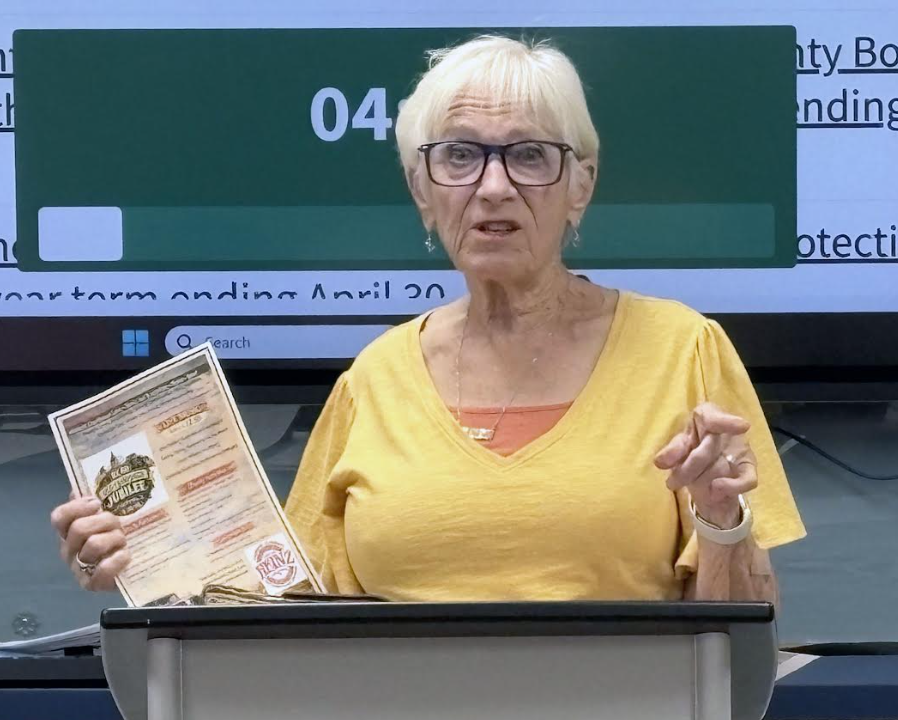
Mary Tinder addressed the board about upcoming events to celebrate the nation’s 250th anniversary and the 100th anniversary of Route 66, some of which will take place at the Macoupin County Courthouse.
With funding from Illinois Humanities, Carlinville Winning Communities is partnering with the Macoupin County Historical Society to sponsor a series of “community conversations” related to the signing of the Declaration of Independence. On the morning of July 4, high school students and college students from Macoupin County will publicly read the Declaration in the main courtroom and lead a brief discussion after the reading. Tinder asked board members to recruit at least two students from each of their districts to participate.
In conjunction with the reading, the Lewis and Clark Chapter of the Sons of the Revolution will decorate the courtroom with 40 historic flags.
“It will be a beautiful sight,” Tinder said.
A Route 66 Jubilee is planned for June 6 (the date 6/26/26 represents Carlinville’s zip code) for the courthouse grounds. That event will feature music, food, children’s activities, and presentations by local writers. Other events in the “community conversations” series will take place at the Macoupin County Historical Society.
Tinder urged board members to attend some or all of the events.
James Cloud, Gillespie, addressed the board concerning a controversial move last month to alter the agenda in order to seat a new board member before members of the public had an opportunity to object to the appointment. During last month’s board meeting, Board Chair Schmidt altered the order of business to approve and seat Derek Spudich as a new member, replacing the late Gordon Heuer.
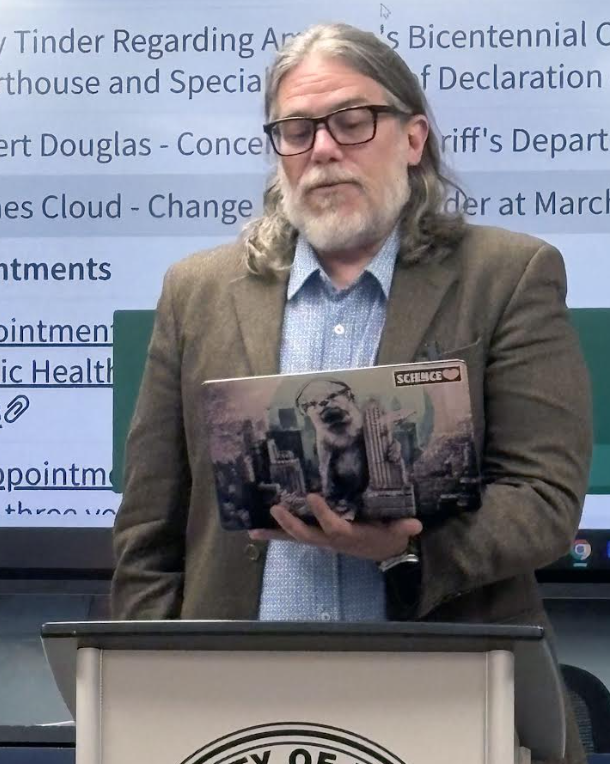
Cloud characterized the agenda-changing action as a ruse to suppress free speech and a violation of the board’s rules that require a two-thirds vote to suspend the rules and change the agenda order.
“The Chairman broke the rules to take a vote before our concerns could be heard,” Cloud said. He said the precedents cited by County Clerk Duncan last month were not applicable to the Spudich appointment.
“Larry (Schmidt) is the only Board Chairman to not call the required parliamentary vote of two-thirds of the Board to suspend the rules in order to administer a change in the agenda,” Cloud said. “Most importantly is that in none of those examples did anyone show up to speak about concerns regarding a nominee.”
Cloud quoted Charlie Kirk on protecting the right of free speech.
“That this wasn’t just an example of inept government procedure,” Cloud concluded. “It was an act to suppress free speech.”
Schmidt pledged to talk with the Sheriff’s Department after Robert Douglas addressed the board, saying a Sheriff’s Department employee had spread rumors about him that are personally defamatory.
“I’ve done nothing wrong,” said an occasionally emotional Douglas. “Fifteen years I’ve been going through this. I can’t even go to my class reunion because people think I’m a monster.”
He said he came to the board on the advice of his attorney, who allegedly plans to sue the county for defamation if the situation is not addressed.
ANIMAL CONTROL
The board voted unanimously to allow the Public Safety Committee to enter into a contract with Buzie Bertagnolli, the former Animal Control administrator who once again stepped in when Colleen Johnson resigned the position in March after being hired in January.
Johnson had replaced Emily Gerl who ran the Animal Control program and animal shelter for 18 months.
50/50 PETITIONS
With a single action, the board voted unanimously to approve four township 50/50 petitions to replace culverts on township roads.
The county will cover half of the $10,000 cost of replacing two 36-inch culverts on a feeder to West Fork Creek in Dorchester Township.
In Hilyard Township, the county will cover half of the $4,000 cost to replace a 40-foot, 36-inch culvert to carry the road over a feeder to May Branch.
Also in Hilyard, the county will cover half of the $6,000 cost to replace two culverts on a feeder to Coop Branch. One culvert is a 36-inch, 50-foot culvert, while the other is a 15-inch, 40-foot culvert.
In South Palmyra, the county will cover half of the $18,500 cost of replacing a 72-inch, 72-foot culvert carrying Illini Lane over a feeder to Nasa Creek.
APPOINTMENTS
With no dissenting votes, the board approved the following appointments:
• Ashley Simmons to fill the unexpired term of Lauren Boente ending on Aug. 31, 2028, on the Macoupin County Public Health Board.
• Paul Boente, reappointed to a three-year term ending April 30, 2029, on the Carlinville Fire Protection District Board.
• Mark Mullen, reappointed to a three-year term ending on April 30, 2029, on the Girard Fire Protection District.
• Linda Petroline to a three-year term ending April 30, 2029, on the Mt. Olive Fire Protection District.
• Anthony Tate, reappointed to a three-year term ending April 30, 2029, on the South Palmyra Rural Water District Board.
OTHER ACTION
In other action the board:
• Approved a resolution transferring $30,000 to the General Fund from the County Farm Account to repay an interfund loan to cover the cost of back pay after a contract with America Federation of State, County and Municipal Employees.
• Agreed to reapply $14,314.80 in American Recovery Plan Act (ARPA) funds to the Courthouse HVAC project from Circuit Court projects.
• Gave the Building and Grounds Committee power to act if the cost of replacing lights at the Courthouse exceeds $10,000. Committee Chair Harry Starr said 125 lights on the second level remain to be updated as the HVAC project nears its end. He said the committee is exploring retrofitting the light fixtures to accept LED bulbs but has not yet received pricing.
• Gave Building and Grounds authority to take bids on razing a house neighboring the Voting Center on the east side. Duncan said the county expects to close on the $79,000 purchase by mid-June and would like to demolish the house as soon as possible to avoid liability issues.
Comments











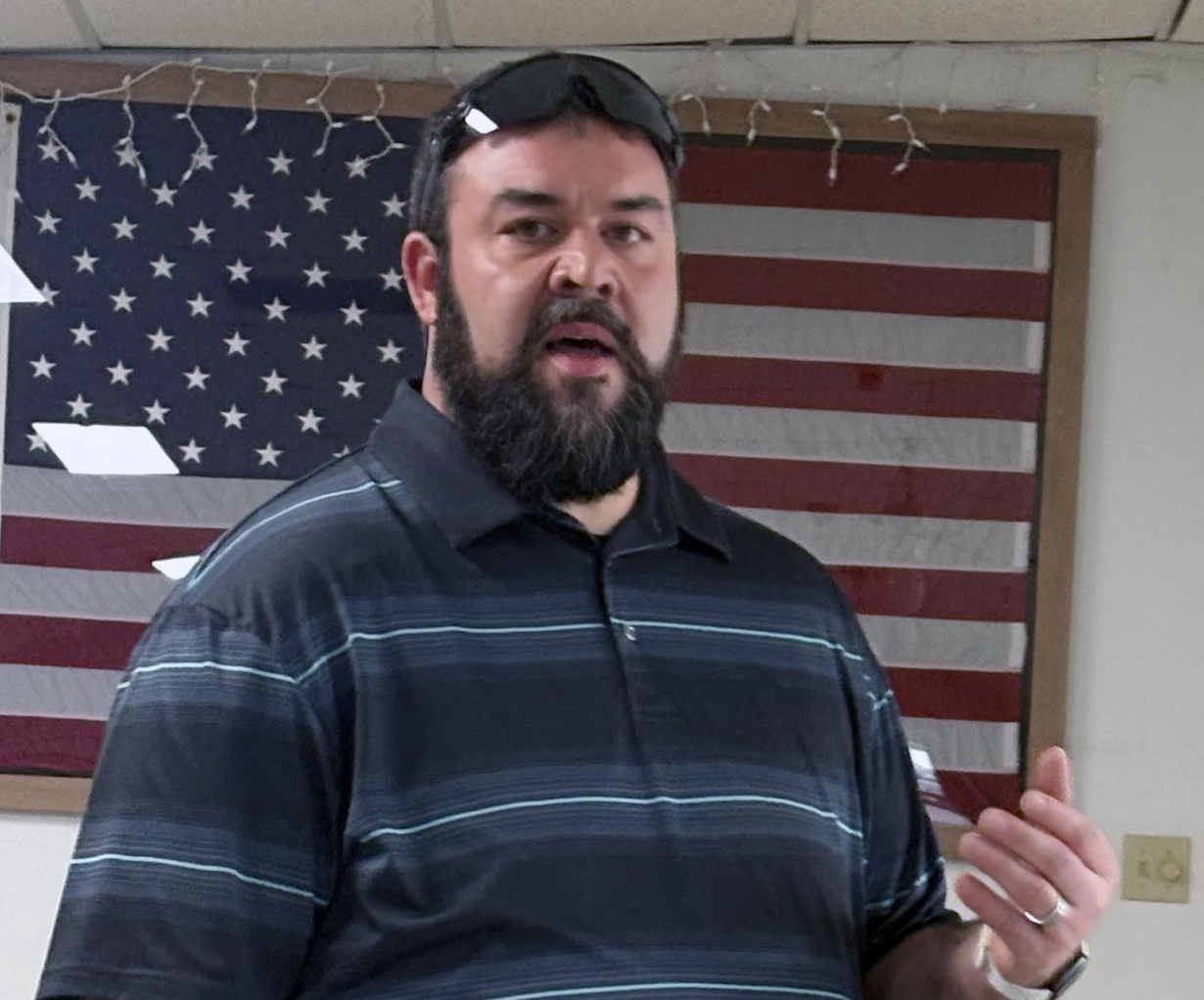
An engineer from Juneau Associates, Inc. Edwardsville, outlined sweeping improvements to the city’s water and sewer systems that the city may opt to pursue in the future.
“Buckle up,” Mayor Landon Pettit told members of the city council before Anthony “Tony” Vercellino outlined immediate needs and potential future needs during the council’s regular monthly meeting Monday night, April 13.
Vercellino identified repairs and renovations to two sewer system lift stations as immediate needs that need to be addressed.
Though engineers did not yet have cost estimates, Vercellino said both pumps in the systems interceptor lift station are failing. Replacing the pumps with either grinder units or trash pumps is necessary to keep the lift station in operation. During previous meetings of the council, Sewer Department Manager Ethan Martin has said he has been having to replace pumps periodically to keep the lift station operable. One of the main culprits, both Martin and Vercellino said, are purportedly “flushable” baby wipes.
“They may say they’re flushable but they’re not,” Mayor Pettit said.
A main flow lift station is in need of a new electronic control panel to enable city employees to monitor the status of its operation off site.
In addition to the lift station work, Vercellino said Pettit asked him to draw up a proposal to create a designated site for waste haulers who add sewage to the city’s system for processing. Vercellino said the dedicated site would alleviate situations where waste haulers “pop a manhole cover” to unload waste.
Vercellino said he is working on a proposal for all three projects which presumably will include engineers’ cost estimates for council action at a later date.
For the longer term, Vercellino outlined a number of projects that would run into millions of dollars over a period of several years. He recommended seeking a low interest loan through the Illinois Environmental Protection Agency Agency to improve the city’s water and sewer systems.
“My recommendation is to get as much money as you are comfortable with,” Vercellino said, and pay it back over 30 years at an interest rate of one to two percent. Under the right circumstances, according to Pettit, the city may be eligible for forgiveness on as much as 30 to 60 percent of the principal
Vercellino said the long-term projects are not critical but would avoid problems in the future. “These are not critical projects,” he said. “You’re not being fined right now.”
One area in need of attention is the chemical storage area at the water treatment plant, which currently does not meet EPA standards. There also is a need to complete and pressure test a new supply line from between the lake and the treatment plant to deliver raw water. Vercellino said Juneau engineers also are looking at the possibility of raising the lake level in lieu of dredging to increase water storage capacity. Raising the water level one foot, he said, would result in an additional 1.3 million gallons and only minimally affect the shoreline profile.
According to Vercellino, the city should consider a hydraulic study to provide the city with “a computer model of the distribution system” in the city and satellite communities that get water from Gillespie. The study also would provide engineers with an understanding of where additional fire hydrants may be needed to not only improve water quality but also improve fire protection.
Vercellino also recommended getting flow testing done on existing hydrants in conjunction with the Community Unit 7 Fire Protection District’s annual hydrant flushing. Flow testing hasn’t been done since sometime in the 1990s and getting it done now should result in lower home insurance rates for homeowners.
“It’s not cheap to get flow testing done,” Vercellino said. “The fact the Fire Department is willing to do this with us is a major advantage.”
“One of the biggest problems we have is with maps and locating water and sewer lines,” Pettit said, adding that the city is using maps from the 1930s to find underground water and sewer lines. On his recommendation, the council voted unanimously to purchase a subsurface locator from Subsurface Solutions, Inc.,at a cost of $15,092.20, with the cost split evenly between the Water and Sewer funds.
Later in the meeting, Martin expounded on issues with the city’s two sewer system lift stations. In January, he said, the city installed a new $20,000 pump in the interceptor lift station only to have it burn out eight days later. The culprit, again, was “flushable” baby wipes clogging the trash system.
“We can’t continue to drop 20 grand every couple of months,” he said. “I can tell you, it’s not going to get any better.”
Ald. Dona Rauzi suggested asking resident to refrain from flushing baby wipes.
“It’s a problem everywhere, not just here,” said Ald. J.Q. Hatleman. “The problem is we have the wrong pump in that station.” He suggested seeking a $10 million loan for 10 years to address the issues at both lift stations.
Martin said IEPA is recommending the city repair aerators at the sewage lagoon and remove vegetation from rip-rap around the lagoon, but neither recommendation is a priority.
“These are recommendations,” Martin said. “These are things they want to see done but they’re not critical. We are not of noncompliance.”
BANK LOAN
On a motion by Ald. Wendy Rolando, seconded by Ald. Janet Odell-Mueller, the council approved a plan to open a line of credit with United Community Bank and secure it with a $125,000 certificate of deposit. Mayor Pettit said the city is renewing an existing $100,000 certificate of deposit and buying a new $125,000 certificate of deposit with money from the Water Department Fund.
The credit line will preclude the necessity for inter-fund loans that have to be paid back before the end of the fiscal year.
“This gets us out of the cycle we’ve been in the last few years,” Pettit said. “Essentially, we are borrowing our own money.” He said the interest rate on the loan is essentially the same what the city earns on the certificate of deposit.
LIBRARY ASSIST
Without taking formal action, the council generally agreed to loan the Public Library up to $10,000 if needed. Librarian Steve Joyce told the council the library may come up short on a roofing project if Climate and Equitable Jobs Act (CEJA) grant money is not released in time.
Joyce said the library has been paying for improvements from the renovation fund but could run out of money while waiting for CEJA money to be released. The library was set to receive about $60,000 in CEJA dollars. It has already spent about $48,000 for repairs, an entry door, and materials for the roofing project.
“The roof needs to be fixed immediately,” Joyce said, adding that the library may not be able to come up with the balance without the city’s help. He asked the city to front the library $10,000 with the expectation the library would reimburse the city when CEJA funds are released.
Delays in releasing CEJA has been an increasingly common complaint from local governments who have committed to spending funds due to them.
“My understanding is that they are going through everything line by line,” Pettit said, before disbursing funds.
In a related CEJA matter, the council approved using CEJA funds to pay a $10,000 third installment for a Business Boot Camp that took place last year.
CIVIC CENTER RATES
The council unanimously approved a resolution implementing a rental fee structure for non-profit groups renting the Civic Center. Under the new rates, non-profit groups are exempted from paying a damage deposit fee.
STREETSCAPE MAINTENANCE SCHEDULE
On a motion by Ald. Rolando, the council set a limit of $10,000 to buy flowers and plants for green areas included in the extensive downtown Streetscape development. Rolando said she had consulted with La Bella Fiori to choose plants for the project, while Grow Gillespie members have volunteered to do weeding, watering and maintenance.
While included in the project scope, the landscaping aspect was not part of the contractor’s bid.
“If we’re going to do this, I really think we should do something with our Welcome to Gillespie signs,” Ald. Janet Odell-Mueller commented.
PAY ESTIMATE
On a motion by Ald. Rauzi, seconded by Mueller, the council unanimously approved payment of Pay Estimate No. 8 to Stutz Excavating, Alton, for work completed on the downtown Streetscape project.
“We’re getting close to the end,” Pettit noted. Work on the $4 million improvement project began earlier this year.
STREET ISSUE
A measure to vacate a portion of Virginia Street that is platted but has never developed, was tabled until May while City Attorney Rick Verticchio determines whether or not there is an easement that would preclude the action. Anita McLain, who asked for the measure, owns lots on Clinton Street on both sides of the undeveloped portion of Virginia Street.
“This is a road that doesn’t exist,” said Mayor Pettit. “The road behind it is in East Gillespie.”
Assuming there is no easement, “I don’t see any issue with this,” said Pettit. “It was previously used as a driveway.”
MEMORANDUM OF UNDERSTANDING
City aldermen approved a memorandum of understanding with the Village of Mt. Clare to link Mt. Clare’s storm siren system with Gillespie’s. The city has similar agreements with Benld and Wilsonville. City Attorney Verticchio said the agreement exempts the city from liability in the event the link does not work.
MOWER PURCHASE
The council gave the committee power to act on the purchase of two Cub Cadet self-propelled lawn mowers at a cost of about $680 each.
OTHER ACTION
In other action, the council:
• Approved a business license for the Snack Shack, owned by Caysea Gray, at 201 W. Pine St.
• Agreed to pay $1,320.78 in delinquent property tax on 307 East Elm St. The property was acquired by the city through a nuisance property action. Now that it is owned by the city, the property will be tax exempt going forward.
• Approved a liquor license for the Coal Country Kitchen, formerly the Barracks, at 206 W. Spruce St.
• Approved a 60-day liquor license for Jumping’ Jimmy’s, 506 E. Elm St., pending the hiring of a new general manager.
Comments
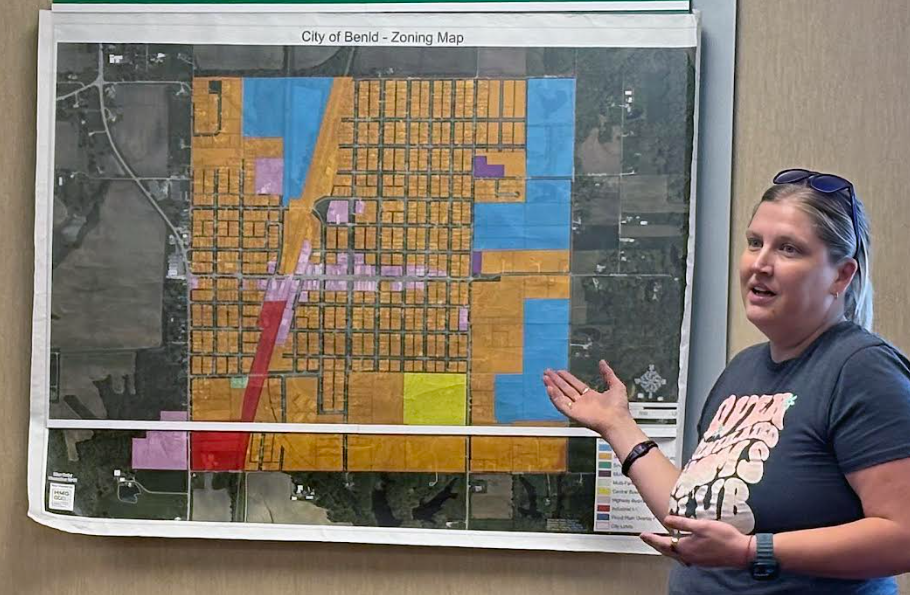
Members of the Benld City Council on Monday night approved two zoning variances for David Wycoff and Ben Maracacci but decline to override the Zoning Board’s decision to deny a petition for a zoning reclassification on the city’s east side.
Amanda Yeager appeared before the council, hoping the council would override the recommendation of the Benld Zoning Board regarding reclassification for a parcel of property on the east side of Illinois Route 138 across from the Cabin Bar and Restaurant. Yeager was referred to the Zoning Board in January after she appeared before the council hoping to have the parcel reclassified from residential to agricultural use. At that time, she told the council she wanted the property rezoned to make it more sellable. On Monday night, however, she indicated that she plans to build a house on the property a keep one to three farm animals—horses, goats and/or sheep.
Yeager pointed out that the property is surrounded by property already zoned for agricultural use. Two out of five property owners neighboring the Yeager property objected to the Zoning Board regarding the reclassification. One of those property owners, Yeager pointed, lives on property that already is zoned for agricultural used.
“It’s not a democratic process,” City Attorney Rick Vericchio explained. Even though a majority of the neighbors either supported or have no opinion on the matter, the Zoning Board could base its recommendation on other factors.
According to Yeager, some members of the Board told her privately after the hearing that if they had known about the number of neighbors who supported or had no objection, they would have voted to recommend reclassification.
“You want this council to override the Zoning Board?” Mayor Jim Kelly asked Yeager.
When Kelly called for a motion to reclassify the property, none of the aldermen responded. “I would need more information before I vote on this,” said Ald. Jerry Saracco. With no motion on the floor, the matter died.
Ald. Norm Emmons advised Yeager to reapply to the Zoning Board and restart the hearing process, after which the council could vote on the Board’s recommendation.
The council was unanimous in granting a zoning variance for Ben Marcacci to build duplexes on two of three lots at 311 W. Central Avenue, 208 West Spruce and 210 West Spruce. Marcacci reportedly plans to build a home on speculation on the third lot.
The council also was unanimous in granting a variance to David Wykoff to bring in a mobile home for 18 months while he builds a new home on 4.83 acres of property just off Cahokia Street. Wykoff said he will consult with the Macoupin County Department of Public Health to advise him on installing a septic system to service the new home.
In other housing action, the council voted unanimously to declare 206 South Second Street a public nuisance—a formality that authorizes the City Attorney to send a letter to the owners demanding they clean up the property within 60 days. The home reportedly is vacant and needs to have the grass mowed.
Council members also discussed an ongoing public nuisance case against property at 306 Park Avenue. Brian Komanetsky, owner of the house, is pursuing an eviction action against the occupant and has promised the city he will clean up the property once the tenant is removed. An eviction hearing is set for April 28.
“By our next meeting we’ll have a better handle on when she will be out,” Veritcchio advised. “Does he intend to clean it up? He says he does.”
STOP SIGN
On the recommendation of Ald. Dustin Fletcher, the council voted 5-1 to install a stop sign on Short Street at Willow Street. Fletcher said residents in the area complained about speeding vehicles on Short Street.
Ald. John Balzraine cast the single “no” vote.
ANNUAL AUDIT
The council gave the Mayor power to act to retain Scheffel Boyle Public Accountants to complete the city’s annual audit at a cost not to exceed $20,000. The accounting firm had not submitted a formal proposal before Monday night’s meeting. Last year, the audit was completed at a cost of $18,500.
City Clerk Terri Koyne reminded aldermen the firm already has been retained at a cost of $5,000 for a special audit of IDNR grant funds expended on building the new Benld Family Sports Complex.
CEJA PROJECT
Council members voted unanimously to spend about $5,000 in Climate and Equitable Jobs Act (CEJA) grant money to install a new floor and paint in the former City Hall when the CEJA grant funds become available. The renovated space will be offered as a community meeting venue for civic group meetings.
GOLD STANDARD AWARD
Ald. Balzraine announced that the DeStefane Events Center was recognized as a Gold Standard award recipient by the Macoupin County Department of Public Health for compliance with food handling safety regulations. The Events Center was one of 33 recipients recognized by the Health Department.
Balzraine said Sue McCoy is in charge of ensuring the Events Center is in compliance and “she does a fantastic job.”
Comments
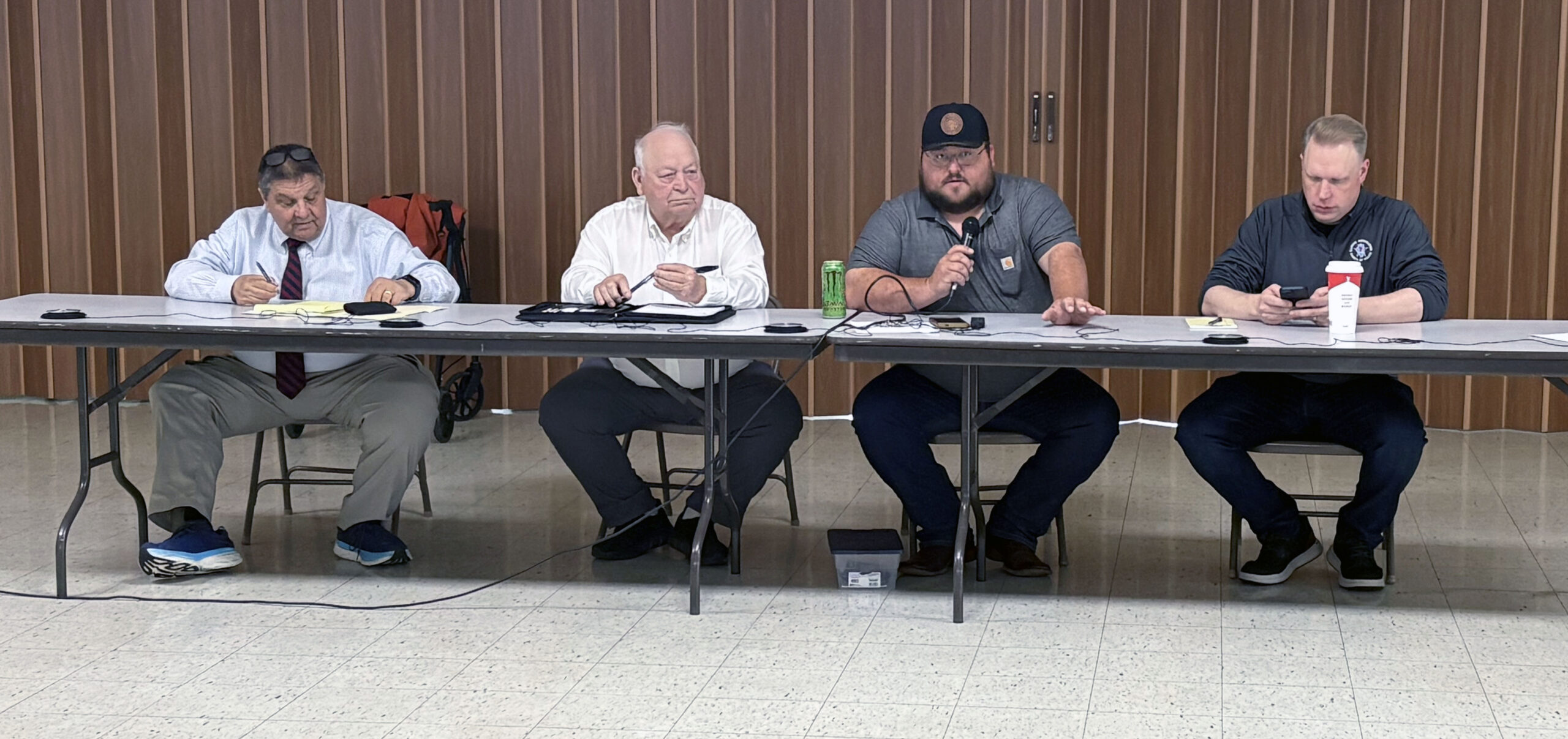
Public officials and community members from throughout the county took steps toward seeking legislation to authorize the formation of police protection districts in the State of Illinois. About 40 people, representing at least nine Macoupin municipalities, met Saturday morning at the Gillespie Civic Center to discuss the issue and move forward on forming a steering committee to approach state legislators.
“We’d like to get the support from other communities in the county to get some kind of legislation,” said Gillespie Mayor Landon Pettit, who co-chaired the meeting with Benld Mayor Jim Kelly, Gillespie Police Chief Jared DePoppe, and Rick Verticchio, city attorney for both cities.told the group.
Among the issues facing smaller communities like Gillespie and Benld are rising the rising costs of providing police protection and increasing difficulties in recruiting candidates to serve as local police officers due to budgetary constraints.
“There are hardly any agencies in Macoupin County that are fully staffed,” Chief DePoppe told the group. “I suspect other counties have the same situation.”
The City of Benld disbanded its Police Department several years ago and contracted with the City of Gillespie to provide police services. Gillespie also contracts for police protection for East Gillespie, Eagarville and Mt. Clare. Benld pays $20,000 monthly for police protection and is currently in negotiations with Gillespie for a new contract with a presumably higher price tag. Other communities also pay a monthly fee that places a burden on local governments.
Pettit said the City of Gillespie spends about $2 million annually on police protection. Fees charged to satellite communities, he said, covers the cost of gas and the hourly salary for officers patrolling in those communities. “It doesn’t include dispatchers, it doesn’t include squad cars,” he said.
A police protection district would have taxing authority to raise money to provide police services. While it would likely increase property taxes for local residents, it would relieve some of the strain on municipal budgets.
As the cost of policing becomes more expensive, the competition for police officers also is greater, DePoppe said.
“We don’t have the police departments we had 20 or 30 years ago,” he said. “We’re not getting new officers like we used to.” In the past, police departments often were able to hire officers who live in the community. More recently, municipalities have been forced to hire patrol officers from surrounding communities. Small communities complain that they often pay for police academy training for new officers, only to see them leave for larger police departments after a few months.
DePoppe emphasized that creating a police district would be optional. “Our hope once this is passed, other counties will come aboard.”
Securing legislation is likely to be a lengthy process, DePoppe warned. “This is going to take time,” he said. “If we don’t start now, I’m concerned about where we will be in three or four years.”
“In the State of Illinois, you can have a water district and you can have a fire district,” Pettit said. “You can have any kind of district you want, but you can’t have a police district.”
To have the option of forming a police district, the state General Assembly would have to approve legislation and the Governor would have to sign it into law. Such legislation would define the nature of police protection districts and make them taxing bodies independent of the municipalities they cover. Presumably, a police protection district would be subject to a board of directors similar to fire protection districts and water districts.
“This is something I’ve wanted to do for a long time,” said Benld Mayor Kelly. “To me, a police district makes a lot of sense.”
Even if legislation is passed and signed, the decision on whether or not to form a police district would be in the hands of voters. As an example voters could petition to form a Community Unit 7 Police District, using the same boundaries as the school district. The referendum could be written to require each and every municipality in the proposed district to approve of the measure, or it could be written so that communities where the referendum failed would simply be excluded from the new district.
“I would like for each and every one of you to contact your legislators and ask for legislation,” Pettit told the group. “If I go to Springfield and tell them I’m the Mayor of Gillespie and I want to see Governor, they’re going to say, ‘Where?’, but if I go to Springfield and say I have 12 mayors with me, they’re going to see us.”

Verticchio said the next steps in the process will be to contact state legislators and circulate petitions in support of the issue. He said he would prepare sample letters local officials and residents can send to General Assembly members.
“We need legislation to police rural communities the way rural communities need to be policed,” Pettit told the group. “Sending in the State Police is not going to help and sometimes makes things worse. We’d like to get support from other communities to get some kind of legislation approved.”
Relying on the Macoupin County Sheriff’s Department to fill in the gaps in patrolling is not feasible logistically because of limited personnel and the physical size of the county. Comprising about 868 square miles, Macoupin County is roughly a square nearly 26 miles wide and 30 miles long. The Sheriff’s Department has only two deputies on patrol at any given time—one for the south half of the county and one for the north half. If local police put out a call for back-up, a Sheriff’s deputy could be more than 20 miles away.
By way of comparison, Verticchio said Madison County has 19 deputies on duty at any given time. To match the officer per square mile ratio, he said, Macoupin would need about 11 deputies per shift.
“We don’t police populations,” Pettit noted. “We police by area.”
Ryan Dixon, who recently won the Republican primary to run for Macoupin County Sheriff, attended the meeting and generally agreed with the police district approach. “I think this could be the start of something positive,” he said.
Former Gillespie Treasurer Dan Fisher warned that “a police district is not a panacea.” The idea that a police district could support itself strictly on tax revenues is unlikely.
“To be clear, this isn’t going to be cheap,” Fisher said. A one percent sales tax for public safety purposes would generate about $250,000 in Gillespie and $75,000 in Benld—a total of $325,000 against an annual expenditure of $2 million. While the district would have the ability to collect real estate taxes, those tax levies would be subject to PTELL (Property Tax Extension Limitation Law). He suggested the plan will not work without some input of state dollars.
“I think this (police districts) is a necessary step but let’s be clear about what is needed to make it work,” he said. “It’s not going to cut our costs but it’s an opportunity to spread the true cost of police protection over the population. It’s not a panacea but it is economic justice. There is a gap that has to filled. We have to have a mechanism to pump money in.”
Parkeoka Huddleston from Royal Lakes questioned how easily the legislature could be convinced to sent money downstate. The metropolitan Chicago area, he said, gobbles up 85 percent of the state’s public revenue, leaving only 15 percent for downstate. The bulk of that money gets used for infrastructure grants for such things as water and sewer improvements.
“They want you to apply for infrastructure,” he said, “but, guess what, crime isn’t going to stop.”
More than half of those attending signed up as volunteers to serve on a steering committee to take the process to the next levels.
After the meeting, Mayor Kelly said he was pleased with the turnout and the questions that were brought up and answered.,
“It’s a good start,” he said.