Community News
School board approves $19.2 million budget


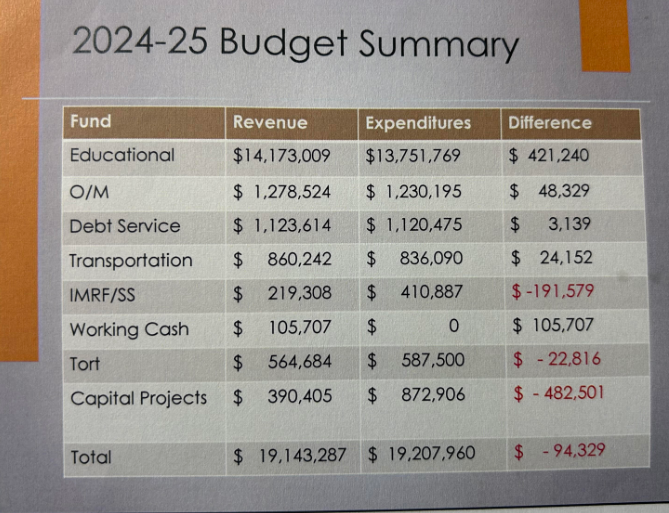
Members of the Community Unit School District No. 7 Board of Education on Monday night unanimously approved a $19.2 million budget to govern spending for the fiscal year that began July 1. The action followed a 15-minute public hearing during which Supt. Shane Owsley discussed details of the tentative spending plan. Owsley cautioned that although the budget has to be filed with the Illinois State Board of Education by Oct. 1, the document approved Monday night is likely to change because some areas of revenue of expenditures cannot be known by the time the budget is due.
“There are always projects going on or things that come up and things we have to address,” Owsley said. Additionally, he said it is not possible to accurately predict what grants and the amounts of those grants the district might receive during the course of a year. The fiscal 2024-25 budget is similar to last year’s budget, which projected revenue at $20,699,566, with expenditures estimated at $19,532.378. The current year’s budget projects revenue at $19,143,287, with expenditures projected at $19,207,960. While the new budget technically is in deficit by $94,329, the district will end the fiscal year with positive balances in all funds due to healthy end-of-the-year balances in all funds.
The Education Fund represents the lion’s share of the budget, with revenue projected at $14,173,009 and expenditures estimated at $13,751,769. State funding is expected to provide 69 percent of the Education Fund’s revenue, including evidence-based funding and special education/pre-kindergarten allotments. As a Tier I school, Owsley said, the district will receive supplemental funding under the evidence-based formula, but he warned the amount of that supplemental funding is likely to decline next year if the local district is kicked up to a Tier II school. Tier status is determined by the school’s percentage of full per capita funding for educating students. When evidence-based funding began, Owsley noted, CUSD 7 was at 67 percent. This year, the district is at 76 percent, just two percentage points away of being elevated to Tier II.
“We may bump up to Tier II next year,” Owsley noted. “What that means is the tier money we receive will start to decrease.”
Local funding, which includes property tax and student fees, is expected to contribute $2,215,562, or 16 percent, to the Education Fund’s total revenue. Federal funding, including grant programs for Title I and Title II, is expected to account for $2,202,146, or 15 percent of the total. Owsley said the federal government’s share also includes Elementary and Secondary School Recovery funds (ESSR). Designed to help school districts recover from the impact of COVID-19, ESSR funding will end on Dec. 31, meaning next year’s federal share is likely to be substantially less.
Fifty-nine percent of the Education Fund’s expenditures are earmarked for instruction, with two percent allotted for support services and 12 percent for payments to other districts who cooperatively provide educational services for CUSD 7 students. Owsley said he also built in a one percent line item for contingencies in hopes of precluding the necessity of formally amending the budget if expenditures exceed expectations.
Revenue for the Operations and Maintenance Fund are expected to total $1,278,524, which includes $480,284 in local funding, $300,000 from the state, and $475,240 from federal sources, including ESSR funds that will expire at the end of the calendar year. Expenditures are projected at $1,230,195, which includes general maintenance, supplies, utilities and custodial salaries.
The Transportation Fund is expected to have revenue totaling $860,242, with 75 percent of that revenue coming from the state government. Expenditures, totaling $836,090, will include $651,699 (78 percent) for driver salaries and supplies, and $184,391 earmarked for debt services.
A Capital Projects Fund is expected to receive $390,405, accruing from a state grant and the county’s school facilities sales tax. A total of $225,000 will be transferred from other funds to service a $1.6 million alternative revenue bond issue approved earlier this year. Additionally, there will be a $75,000 abatement to taxpayers, as agreed when the one-cent sales tax was approved by voters. The district plans to spend $872,906 from the Capital Projects fund for various capital improvement projects.
For debt services, the budget expects $1,123,614, which will come entirely from local sources including real estate taxes and a county-wide school facilities sales tax, plus $219,308 for the lllinois Municipal Retirement Fund and Social Security contributions. Expenditures are projected at $1,531,362, including payments of $410,887 for the Illinois Municipal Retirement Fund and Social Security contributions, and $1,120,475 for debt services.
The Tort Fund, which covers legal expenses and insurance premiums, is expected to take in $564,684 and have expenditures of $587,500.
The Working Cash Fund, basically a “rainy day” fund that can loan cash to other funds, will have revenue of $105,707 with no anticipated expenditures.
Three of the funds are projected to be in deficit for the fiscal year. Expenditures are expected to exceed revenue by $91,579 in the IMRF/Social Security Fund, $22,816 in the Tort Fund and $482,501 in the Capital Projects Fund. Because each of those funds have surplus balances, however, all district funds are expected to end the fiscal year in the black. The Capital Projects fund, for example, received an injection of $1.6 million last fiscal year due to the alternative revenue bond sale. That revenue was reflected in last year’s budget, while expenditures from those funds are expected to take place over the next three years.
Allowing for existing balances at the beginning of the fiscal year, the district is expected to end the currently fiscal year with $14,655,840.
According to Owsley’s projections, the Education Fund ended the last fiscal year with a balance of $7,532,031 and is expected to end the current fiscal year with $7,953,271. The Operations and Maintenance Fund had $772,872 at the end of last fiscal year, and is expected to have $821,201 at the end of the current year. Starting with a balance of $518,728, the Transportation Fund is expected to have $542,880 at the end of the current fiscal year. Capital Projects had $1,968,901, due in part to the bond sale, and is expected to end the year with $1,486.400. Debt Service is expected to have $398,697 at the end of the year. IMRF/Social Securities started with $597,467 and is expected to end with $405,888. Starting with $173,558, the Tort Fund is expected to end the fiscal year with $150,742. With zero expenditures expected, the Work Cash Fund is likely to grow from $2,791,054 to $2,896,761 at the end of the fiscal year.
Though allowed by the School Code, CUSD 7 does not have a Fire Prevention/Life Safety fund, Owsley noted. That’s because the limitations imposed by the Property Tax Extension Limitation Law (PTELL), the district cannot levy a tax for the fund without exceeding the tax cap. However, Owsley reported, legislation is being proposed that would allow districts subject to tax caps to levy a Fire Prevention/Life Safety tax without it counting against the cap. If that legislation is passed into law, the district would be able to levy a tax for that fund, thereby establishing a new base for future tax levy calculations.
DISTRICT FOCUS
Macoupin County CEO Board Chair Scott Reichmann asked the board to consider making a $1,000 “investment” in the innovative countywide education program that trains high school seniors in entrepreneurship. Launched in 2017 by a group of Carlinville area business leaders headed by Karmak founder Richard Schein, the Macoupin County Creating Entrepreneurial Opportunities (CEO) provides training to equip high school seniors with the tools they need to launch a business later in life. All eight Macoupin County school districts participate.
Reichmann said this year’s CEO class comprises 12 students, three of whom are from CUSD 7.
“You can tell who the leaders in Gillespie are going to be,” Reichmann said, referring to the GHS seniors.
Reichmann said the class meets in a location that is somewhat centrally located for most students. This year’s class has been meeting at the Illinois Coal Mining Museum in Gillespie. With eight districts involved, some students have a half-hour drive to attend the class.
Each student is assigned a “mentor” from among 30 business leaders on the program’s mentor roster. During the course of the year, students will brainstorm a new business from the ground up, developing a product or service, writing a business plan, and exploring how to finance and promote their business start-up. At the end of the year, the students participate in a CEO Trade Show where they showcase their concepts. Some students in the past have gone on to actually establish the business they developed in the CEO Program.

“I’ve been involved with this from the start,” Reichmann said. “I love this program.”
He told the board the CEP Program is approaching all eight districts in the county to ask for a $1,000 investment. The program receives no state or federal funding and is funded entirely by donations, primarily from Macoupin County businesses. Reichmann said the program typically operates on an annual budget of $35,000 to $40,000, which includes the salary paid to the program facilitator. The Macoupin County program also pays a fee to the Effingham CEO program, which is the parent program for the program in Maocupin County and other areas.
Answering a question from board member Amanda Ross, Reichmann said students can earn college credit through the program if the facilitator has a master’s degree. Former facilitator Pete Visintin held a masters degree. The current facilitator does not, but Reichmann said the local board is working with the Effingham parent program to find a way to offer college credit.
Reichmann was accompanied by Josh Ranger who completed the program in 2022.
“I truly believe it is one of the best classes you can take,” Ranger said. “It had a big impact on my life. It teaches you things from how to talk to people to how to run a business.”
STRATEGIC PLAN
Board members received a new Strategic Plan for the district to guide the district in various areas over the next five years. Written over a period of about 18 months, the new plan was drafted by a 24-member committee that included community members, district administrators and teachers, and two school board members, along with the maintenance director and transportation director.
“This is very impressive,” Board President Mark Hayes said, thanking the committee members who worked on the document.
“This isn’t something that’s going to sit on a shelf,” said Supt. Owsley. “This is going to serve as the roadmap for us for the next five years.” He said he was pleased to report that some of the initiatives outlined in the plan are already being implemented in the district.
The last five-year plan was drafted in 2014 and actually expired in 2019. The work on an update was delayed as a result of the COVID-19 pandemic.
The updated plan focuses on five strategic areas:
• Growth and Development: which includes introducing middle school and high school students to college and career opportunities, promoting off-campus certification programs, expanding the fine arts program, expanding advanced learning and college credit opportunities, and increasing parent involvement in district initiatives.
• Student Mental Health and Physical Well-Being: which includes fostering development of social skills, providing additional food options to improve nutrition, and providing more choices for educational and extra-curricular opportunities.
• Community and Culture: which emphasizes educational opportunities to prepare students to manage personal finances and understand financial responsibility, ensures career or college readiness on the part of GHS graduates, creates a sense of community within the district, and increases sponsorship of non-athletic clubs and organizations within the district.
• Campus Environment: which includes improving and maintaining infrastructure, providing for campus safety and emergency protocols, upgrading libraries and media centers, improving campus parking, upgrading district transportation, and upgrading and maintaining playgrounds at the elementary level.
• Financial and Fiscal Responsibility: which directs the district to seek additional revenue through grants and other resources, manage spending for the greatest efficiency, invest funds for maximum returns, and focus on facility upgrades including enhanced safety measures and expanded scholastic opportunities.
SIXTH DAY ENROLLMENT
The board briefly reviewed sixth-day attendance figures, which is the basis on which school aide formulae are calculated. The number of students enrolled and attending on the sixth day of school this year is down from the previous year, continuing a trend for declining enrollment over the past ten years.
School attendance on the sixth day in CUSD 7 totaled 1,073, which included 498 in elementary school, 245 in middle school and 330 in high school. The total attendance is down from a peak of 1,344 in 2017-18, and a ten-year average of 1,225.
“This is the lowest our enrollment has ever been and it’s not even close,” Owsley said. “We are seeing a pretty dramatic decrease.” Declining enrollment is a countywide phenomenon, according to Owsley, but it will have an impact on staffing needs, budgeting, and other areas.
Without taking formal action, the board authorized Owsley to purchase a $5,000 program from Frontline Analytics which will help project enrollment in the future on the basis of live births, compare test scores with districts of similar size, compare financial information with other districts and otherwise analyze available data.
SUPERINTENDENT’S REPORT
Supt. Owsley reported to the board that CUSD 7 has been selected to receive a $221,635 Stronger Connections grant which will be used to support Social-Emotional Learning (SEL) staff at BenGil Elementary School. Owsley also reported he has been selected to be a presenter, along with superintendents from Mount Olive, Sparta and Marissa, for a session on Social-Emotional Learning at the American Association of School Administrators next March in New Orleans.
STUDENT DISCIPLINE
Upon returning from a 35-minute executive session, the board voted unanimously to “hold in abeyance” the expulsion of an unidentified student, and transfer the student to the Macoupin County Alternative School for no less than the first semester of the current school year. The action essentially allows the student to avoid being expelled by attending Alternative School classes. The action also allows the student to continue to earn credits toward graduation.
PERSONNEL
Also following the brief closed-door session, the board voted unanimously to hire Chris Fenton as a district custodian.
Laurie Price was hired as a special education bus aide, pending verification of certification and a background check. In separate actions, the board accepted the resignation of Bennie Maddox as a full-route bus driver and rehired him as a substitute driver. Billy Bowles was unanimously employed as a full-route bus driver. Mark Smith was hired as a substitute driver, pending verification of certification and a background check.
The board accepted the resignation of Emilie Campbell as a paraprofessional classroom aide, effective Aug. 22, and hired Shelby Maguire as a paraprofessional classroom aide, pending verification of certification and a background check.
Board members unanimously accepted the resignation of Jan Allan as a part-time cafeteria work and posted the position as vacant.
OTHER ACTION
In other action, the board:
• Voted unanimously to apply for a $6,000 school maintenance grant.
• Changed the date of the December board meeting from Monday, Dec. 16, to Wednesday, Dec. 18.
Comments










FELONIES
Justine D. Pocklington, 27 of Standard City, possession of methamphetamine (<5 grams), aggravated feeling police/21 mph over, no valid registration, and operating an uninsured motor vehicle in connection with a February 2 incident.
MISDEMEANORS
Katlyn N. Pilger, 21 of Benld, is charged with theft/unauthorized control (<$500) in connection with a March 28 incident.
Donald L. Lloyd, 46 of Staunton, is charged with criminal trespass to land in connection with an April 5 incident.
TRAFFIC
Tarina S. Slaughter, 47 of Girard, is charged with improper use of registration/title, unlicensed, and operating an uninsured motor vehicle in connection with an April 4 incident.
William C. Geiser, 60 of Gillespie, is charged with reckless driving in connection with an April 6 incident.
Lauren E. Wolfe, 21 of Granite City, is charged with improper use of registration/title and expiration of registration in connection with an April 3 incident.
Jim T. Wahl, 53 of Cottage Hills, is charged with driving on a revoked license in connection with an April 8 incident.
DISSOLUTION OF MARRIAGE FILED
- Nora Washington versus Joseph D. Washington
- Samantha Lehnen versus Chad Wallace
MARRIAGE LICENSES
- Colton D. West of Hettick and Alina M. Carver of Scottville.
- Devin J. Martin and Mariah P. Crane, both of Bunker Hill.
- Jonathon E. Swisher of Shipman and Mackenzie P. Calvin of Saint Charles, MO.
- Lucas Boschelli and Danielle J. Boatman, both of Carlinville.
- Todd R. Leverton and Jennifer L. Bowman, both of Carlinville.
Comments

SUNDAY, APRIL 5, 2026
An officer was dispatched to the 500 block of North 7th Street in Benld in reference to a civil issue.
An officer was dispatched to the 400 block of West Oak Street in reference to a civil issue.
An officer was dispatched to the 300 block of East Oak Street in reference to harassment.
An officer was dispatched to the 200 block of South Main Street in Benld in reference to a civil standby.
An officer was dispatched to the 100 block of Park Avenue in reference to a 911 call.
An officer was dispatched to the 300 block of East Elm Street in reference to a civil standby.
An officer was dispatched to a business in the 400 block of South Macoupin Street in reference to a well-being check.
An officer was dispatched to the 500 block of North 7th Street in Benld in reference to a 911 call.
MONDAY, APRIL 6, 2026
An officer was dispatched to a business in the 400 block of South Macoupin Street in reference to a juvenile issue.
Jonathan M. Kirkwood, 29 of Benld, was arrested on a Macoupin County warrant for failure to appear for traffic.
An officer was dispatched to Maple Street and Adams Street in reference to suspicious activity.
An officer was out with a female at Trolley Street and Central Avenue in Benld in reference to suspicious activity.
An officer was dispatched to the Gillespie Police Department to speak with a male in reference to a civil issue in the 200 block of South Main Street in Benld.
An officer initiated a traffic stop at Springfield Road and Henry Street in East Gillespie. Camden G. Zumwalt, 18 of Staunton, was issued a citation for speeding.
An officer was dispatched to the 500 block of North 7th Street in Benld in reference to a 911 call.
An officer was dispatched to a business in the 400 block of South Macoupin Street in reference to a well-being check.
TUESDAY, APRIL 7, 2026
Cory D. Norton, 33 of Columbus, NC, was arrested on a Macoupin County warrant for failure to appear for driving while driver’s license was suspended. He also has a warrant out of Montgomery County for failure to appear while driver’s license was suspended.
An officer was dispatched to the intersection of Madison Street and Wilson Street in reference to a 911 call.
An officer was out with a male at Staunton Road and Charles Street in reference to a traffic crash. Tanner E. Moore, 28 of Gillespie, was arrested for driving under the influence of alcohol, improper lane usage, using an electronic communication device, and failure to change address.
An officer was dispatched to the 800 block of Frey Street in reference to a 911 call.
An officer was dispatched to the 800 block of Staunton Road in reference to a well-being check.
An officer was dispatched to the 300 block of South 4th Street in Benld in reference to unwanted solicitors.
An officer was dispatched to the 300 block of East Maple Street in reference to a 911 call.
An officer was dispatched to the 100 block of Richards Street in reference to a well-being check.
An officer was out in the 100 block of South Main Street in Benld. Amanda L. Broderick, 37 of Benld, was issued citations for unlawful possession of traffic signs and obstruction. Luther C. Welch, 31 of Shipman, was issued a citation for obstruction.
WEDNESDAY, APRIL 8, 2026
An officer was dispatched to the 300 block of Berry Street in Mt. Clare in reference to a death investigation.
An officer was dispatched to a business in the 300 block of North Macoupin Street in reference to illegal dumping and criminal trespass.
An officer was dispatched to the 400 block of North 6th Street in Benld in reference to criminal damage to property.
An officer spoke with a female at the Gillespie Police Department in reference to identity theft in the 1200 block of Second Street.
An officer initiated a traffic stop in the 400 block of South Macoupin Street. Andrea M. Hulsey, 30 of Mt. Clare, was issued a citation for her minor child not wearing a seatbelt.
An officer was dispatched to the 600 block of Broadway in reference to a neighbor dispute.
An officer was dispatched to a business in the 900 block of Springfield Road in reference to suspicious activity.
An officer was dispatched to the 700 block of Abba Street in reference to a juvenile issue.
An officer was dispatched to Ben-Gil Elementary School in reference to a juvenile issue.
An officer was dispatched to the 500 block of East Elm Street in reference to suspicious activity.
An officer was dispatched to Kentucky Street and Hickory Street in Benld in reference to a noise complaint.
An officer was dispatched to the 500 block of East Walnut Street to assist the Macoupin County Sheriff Department in serving an eviction notice.
An officer was dispatched to the 300 block of Dorsey Road in Mt. Clare in reference to a well-being check.
THURSDAY, APRIL 9, 2026
An officer was dispatched to the 200 block of Dorsey Street in Benld in reference to a medical assist.
An officer was dispatched to the 700 block of Donaldson Street in reference to criminal damage to property.
An officer initiated a traffic stop at Central Avenue and Main Street in Benld. Trinity A. Pruitt, 22 of Benld, was issued citations for speeding and for illegal transportation of cannabis.
An officer was dispatched to the 200 block of Springfield Road in East Gillespie in reference to a civil issue.
The school resource officer brought a child to the Gillespie Police Department in reference to juvenile issues.
An officer spoke with a female at the Gillespie Police Department in reference to a civil issue in the 200 block of West Spruce Street.
An officer was dispatched to the 2300 block of Staunton Road in Mt. Clare in reference to suspicious activity.
An officer was dispatched to the 700 block of Clay Street in reference to a 911 call.
An officer was dispatched to the 400 block of East Central Avenue in Benld in reference to suspicious activity.
FRIDAY, APRIL 10, 2026
An officer was dispatched near the water plant in reference to juveniles fighting.
An officer was dispatched to the 300 block of South Second Street in Benld in reference to assisting the Litchfield Police Department with a case.
An officer was dispatched to the 400 block of West Wilson Street in reference to a 911 call.
An officer was dispatched to the 400 block of Charles Street in reference to a civil issue.
An officer initiated a traffic stop at Springfield Road and Henry Street in East Gillespie. Leonard J. Schwartz, 55 of Edwardsville, was issued a citation for speeding.
An officer initiated a traffic stop at Macoupin Street and Pine Street. Scott A. Byrd, 49 of Wilsonville, was issued a citation for expired registration.
SATURDAY, APRIL 11, 2026
Larry E. Conlee, 42 of Mt. Clare, was arrested on a Macoupin County warrant for failure to appear for dangerous drugs. He was also arrested for resisting a peace officer and aggravated battery.
An officer spoke with a female at the Gillespie Police Department in reference to an animal complaint on Bishop Drive at Gillespie Lake.
An officer was dispatched to the 200 block of South Hard Road in Benld in reference to a domestic dispute.
An officer was dispatched to the 400 block of East Walnut Street in reference to solicitation.
All subjects are presumed innocent until proven guilty in a court of law.
Comments
Community News
“History Belongs to All of Us”: Focus of Carlinville Community Conversation Series starting May 4


“History Belongs to All of Us,” a three-month series of events and activities commemorating the 250th anniversary of American independence and emphasizing Illinois’ role in seizing liberty for the American people will kick off Monday, May 4, and continue through July 16, 2026.
The series is project of Carlinville Winning Communities funded by a grant from Illinois Humanities. The events will encourage participants to examine and discuss the Declaration of Independence and other primary historical documents through facilitated conversations, according to Mary Tinder, a Macoupin County Historical Society & Carlinville Winning Communities board member.
Carlinville Winning Communities was one of only 13 entities statewide to receive an Illinois Humanities grant to support the Community Conversations Series.
We are fortunate to have received Illinois Humanities funding for this unique project, With 2026 being the 250th anniversary of the signing of the Declaration of Independence and the 100th anniversary of Route 66, it is altogether fitting to explore where we’ve been and where we’re going, as well as to reflect on both and the cultural impact of our independence, Tinder said.
In keeping with the “History Belongs to All of Us” theme, several of the presentations and discussions will emphasize the role of Native Americans and the impact of American independence on Native American and other cultures.
Program topics will be explored through presentations by Illinois Humanities Road Scholars, live readings of historic documents, art, music and discussions. The programs are free to attend and all venues are handicapped accessible.
The series kicks off with “Illinois in the Revolutionary War,” a presentation by local historian and author Tom Emery, at 7 p.m., Monday, May 4, at the Macoupin County Historical Society’s Ruyle Genealogy Building, 920 W. Breckenridge St., Carlinville. Emery will lead a discussion of information included in his most recently published book, Illinois in the Revolutionary War.
“There was more to the war in Illinois than most people realize,” said Emery. “Revolutionary action took place in many parts of the state, and it was a struggle for all involved. It shows how hard many Americans worked for liberty.”
A discussion of Nicholas Welch’s 1812 Land Grant and the Autobiography of Ma-Ka-Tai-Me-She-Kia-Kiak, better known as Black Hawk, leader of the Sauk/Sac Indian tribes, is set for 7 p.m., Monday, June 1, in the Anderson Home parlor on the Macoupin County Historical Society grounds. Under the Land Grant program, the government set aside more than five million acres in western Illinois to compensate American war veterans with large tracts of land. Though Welch never set foot in Illinois, the granting of land to him displaced Black Hawk from his home in the area of present-day Rock Island. The facilitated discussion will focus on original historic documents, juxtaposing Welch’s land grant with Black Hawk’s experience.
Because of the smaller, more intimate venue, reservations are required. RSVP to marytinder1@gmail.com to reserve a seat.
“Relive the Mother Road: The Edwards Trace,” a collective analysis of documents and a look at contemporary research will be led by Illinois Humanities Road Scholar Anna Sielaff, Friday afternoon, June 26, during an Old Fashioned Route 66 Jubilee on the Macoupin County Courthouse lawn. Sielaff will discuss the 3,000-year-old Edwards Trace, used by Native Americans and early Illinois settlers, that stretched from Cahokia to Peoria. Portions of the trace run through Macoupin County, and some sections lay along the original alignment of Route 66. Imagine Rural Arts also will lead an art project in connection with how the trail was marked.
The Old Fashioned Route 66 Jubilee event runs from noon into the evening with food, musical performances, literary presentations, games, food and other activities.
The date is significant for Carlinville and Route 66 since 6/26/26 happens to be our zip code! The Jubilee offers a variety of experiences and taking a deeper look at the Edwards Trace and the Mother Road is an interesting way to explore local history on this unique date and location, Tinder noted.
Continuing on to the July 4th holiday, Macoupin County high school and college students will read the Declaration of Independence aloud in the main courtroom of the historic Macoupin County Courthouse in Carlinville at 10 a.m. The event also will feature a display of more than 30 historic flags provided by the George Rogers Clark Chapter of the Sons of the American Revolution. A facilitated discussion will follow the reading and participants will be invited to sign the “Macoupin County America @ 250 Time Capsule” book. The book will then be on display at the Macoupin County Historical Society, said Andrea Duncan, one of the organizers.
A unique and somewhat mysterious artifact from Macoupin County will be the subject of a presentation at 7 p.m., Monday, July 6, at the Historical Society’s Ruyle Genealogy Building. Sharon Breyden and husband Tommy Breyden will display and discuss the Black Hawk Tablet, uncovered in the 1940s on a farm near Hettick. The odd inscriptions on the lead medallion suggests Black Hawk and an early Macoupin settler formalized an agreement to peacefully coexist in central Illinois.
For the final program of the Carlinville Community Conversations series, Illinois Humanities Road Scholar Kim Sigafus, a member of the Ojibwa Native American tribe, will present “We the Native People” at 7 p.m., Thursday, July 16, at the Historical Society’s Ruyle Genealogy Building. The focus is on Native Americans at the time the Declaration of Independence was signed. The interactive program will use traditional story-telling and music to help audience members understand the groundswell changes in Native American culture and lifestyle resulting from American independence and subsequent western expansion.
For more information and details about the “History Belongs to All of Us” series, contact Carlinville Winning Communities Board members, Andrea Duncan, (217) 204-1446, or Mary Tinder, (217) 825-9699.