

CUSD 7 News
School Board agrees to $2 million Working Cash bond sale


Kevin Wills, vice president for First Midstate, Inc., the company handling the bond sale, told board members his firm had secured an interest rate of 4.7 percent—slightly better than the 5.5 percent rate he originally anticipated.
Voting 4-2, members of the Community Unit School District 7 Board of Education on Monday night authorized the sale of $2 million in Working Cash bonds to shore up sagging finances over the next several years. As part of the package to authorize the bond sale, the board also voted to refinance at a lower interest rate more than $2.4 million in existing bonds and close out the district’s existing Working Cash Fund by transferring a balance of about $50,000 into the Education Fund.
The bond sale had been under discussion since October.
[pullquote]Executing the bond sale at this time reportedly allowed the district to take advantage of favorable interest rates and dodge the possibility of the state General Assembly imposing restrictions upon local school districts’ bonding ability in the near future.[/pullquote]
Executing the bond sale at this time reportedly allowed the district to take advantage of favorable interest rates and dodge the possibility of the state General Assembly imposing restrictions upon local school districts’ bonding ability in the near future. Kevin Wills, vice president for First Midstate, Inc., the company handling the bond sale, told board members that there are “dozens of bills” pending in the state legislature that could have an impact on the Property Tax Extension Limitation Law (PTELL), which limits school districts’ ability to raise property taxes to pay for education.
“It’s hard to tell which of them, if any, will pass,” Wills said. He said there is considerable pressure in the General Assembly to address the property tax issue this year. Quoting another school superintendent who recently participated in panel discussion on the future of PTELL, Wills said it is a “political probability” that something will pass and possibly be signed into law that will have an impact on PTELL.
“All sorts of bills have been proposed,” Wills said. Some would limit the number of years school districts could benefit from a special sales tax to 23. “Some of them don’t even allow for bonds to be issued in the future, some do. Doing this now (issuing Working Cash bonds) allows you to get this done prior to what seems to be a probable legislative overhaul coming out of Springfield.”
Wills also noted his firm had secured an interest rate of 4.7 percent—slightly better than the 5.5 percent rate he originally anticipated. Trimming the interest rate by eight-tenths of a percent is expected to save the district about $30,000 over the eight-year life of the Working Cash bond issue.
Supt. Joe Tieman reiterated that proceeds from the Working Cash bond sale are intended to be used for expenditures “that have a direct impact on students.”
“I want to make sure everyone knows our intent is to spend this money on classroom-related issues,” Tieman said. Those expenditures, he said, could include teacher salaries, classroom equipment or classroom supplies.
[pullquote]I want to make sure everyone knows our intent is to spend this money on classroom-related issues[/pullquote]
Working Cash funds work essentially as an operating fund, shoring up other line-item funds that fall short during the fiscal year. Money can be transferred from Working Cash to another fund as a temporary loan, in which case the money is returned to Working Cash upon receipt of the following year’s property tax distribution. More often, there is a direct transfer of funds with no intention of replenishing the Working Cash Fund later.
Board member Dave Griffel, who will not seek re-election to the board in April, voiced concerns about the bond sale, likening it to “mortgaging your home” for a short-term gain. While acknowledging the advantage of a low interest rate, he pointed out that if the district doesn’t tap into the Working Cash Fund until next December, it will have paid in the neighborhood of $90,000 in interest before spending any of the bond sale proceeds. Additionally, he expressed concerns about whether or not future boards will resist the temptation to spend cash if it is readily available in the form of Working Cash.
Griffel also expressed concerns about maxing out the district’s debt ceiling, although Wills said the district would have other options—such as Life Safety bonds—for borrowing in the event of an emergency. The bond issue and restructuring, according to Griffel will take the district’s total indebtedness from more than $16 million to more than $19 million.
“We’re maxing out things for a one-time influx and that is a concern to me going forward,” Griffel said. “I’m not trying to convince anyone to do anything different; that’s just my concern.”
A resolution to “abate” the existing $50,000 in the Working Cash Fund by transferring it to the Education Fund was unanimously approved on a motion by Jenni Alepra, seconded by Don Dobrino.
The second resolution to issue $2 million in Working Cash bonds and restructure $675,000 in existing bonded debt, however, was opposed by both Griffel and Weye Schmidt. Schmidt paused for several seconds to contemplate his vote before finally voting “no.”
The last of the three resolutions authorized the sale of $1,765,000 in bonds, essentially refinancing the remainder of the district’s bond debt at a more favorable interest rate.
[pullquote]The bond issue and restructuring, according to Griffel will take the district’s total indebtedness from more than $16 million to more than $19 million.[/pullquote]
The pay-back period for the Working Cash bonds is eight years. Bond sales for the $675,000 and $1.8 million in existing debt are expected to take 20 years to repay. The bonds are callable on Dec. 1, 2024, meaning the board could choose to pay them off early if it chooses to do so. Wills described a scenario where the board could use a portion of the proceeds from the county School Facilities Sale Tax program to accelerate repayment, or allow that money to accumulate over several years to make a lump sum payment to draw down the amount of money owed.
Wills was expected to register the bond sales with the Macoupin County Clerk on Tuesday and the sale of the bonds is currently ongoing.

Tieman told The BenGil Post the school district expects to have proceeds from the bond sales in hand by March 21.
GUIDANCE DEPARTMENT AND EVERY STUDENT SUCCEEDS CONFERENCE
The board heard extensive presentations from elementary Title program teachers Suzi Tiburzi and Kimberly Link, regarding their attendance at a recent Every Student Succeeds Act conference, and Kalli Baker regarding the work of the high school/middle school guidance office.
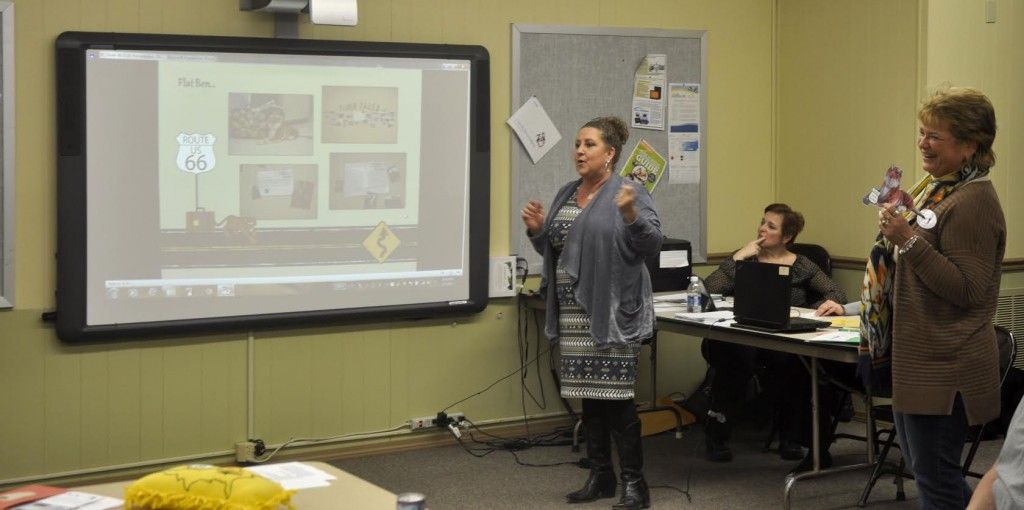
Suzi Tiburzi and Kimberly Link reported that they were asked to present a session on last year’s innovative “Read for Kicks on Route 66,” which encouraged elementary students to read while learning about Route 66, this historic highway from Chicago to California.
Tiburzi and Link reported that they were asked to present a session on last year’s innovative “Read for Kicks on Route 66,” which encouraged elementary students to read while learning about Route 66, this historic highway from Chicago to California. Tiburzi said the teachers teamed with members of the Route 66 Blue Carpet Corridor and local Route 66 enthusiast Dave Tucker, who put them in touch with guest speakers and materials for the program.
As students read more and more pages, cardboard buses were moved along facsimile highways in the school hallways to chart their progress. As the project evolved, Tiburzi said, “it kind of started snowballing and took on a life of its own. We wanted kids to read but a lot more came out of it.”
Ultimately, the project included a t-shirt contest a music program relating to Route 66 and other activities. It culminated with a “sock hop” and a parade of classic cars brought to the school by local car buffs.
“A lot of the kids didn’t know what Route 66 was,” Link said. “They had no idea.”
Tiburzi said the program worked “because everyone pitched in.” Even school cafeteria workers made an effort to come up with menus that fit with the Route 66 theme.
[pullquote]We wanted the kids to read and that’s what happened[/pullquote]
“We wanted the kids to read and that’s what happened,” Tiburzi said. “It started out small and it just kept growing, growing and growing. Everyone was onboard. I think last year was the best year I ever had.” It’s been more difficult, she admitted, to generate enthusiasm for reading this year in the absence of an over-arching theme.
Both women said their conference session was well attended and a number of schools they made contact with now plan to implement similar programs in their own schools.
Tiburzi and Link said they also had an opportunity to attend a number of sessions at the conference, which was designed to address issues related to the Every Student Succeeds Act, a successor to the former No Child Left Behind program.
Keynoter Dr. Adolph Brown spoke about the need for teachers to relate to “every student, every day” regardless of their appearance, ability or social status. Tiburzi said Brown also talked about the need for a leadership team involving faculty members to focus teaching efforts throughout the school year.
“That got me thinking that might be something we are lacking,” she said.
The local teachers said they also attended sessions on Social and Emotional Learning, Soft Skills vs. Hard Skills and Blended Learning.
“The conference was amazing,” Tiburzi said. “It was nice to see teachers from other schools that are having the same problems as us.”
Baker and Guidance secretary Tina Gibson offered an extensive and heavily documented presentation on the work of the guidance department ranging from helping students and parents plan for educational goals to helping students through emotional and social issues.
[pullquote]We call our office ‘student services’ because we don’t want the ‘counseling’ stigma[/pullquote]
“We call our office ‘student services’ because we don’t want the ‘counseling’ stigma,” Baker said.
She said she had concerns about the school district’s high mobility rate—the number of students who move in and out of the district during the year, as well as concerns about truancy and absenteeism. Tieman said the board expects to address truancy and absenteeism during its regular March meeting.
Surprisingly, she noted that “self-injury” is a “major concern” for the counseling department. She said she regularly refers students for counseling after it was discovered that they had deliberately cut themselves. Out of a class of 100 students, half of whom were females, eight were discovered to be cutting themselves. While cutting is a serious concern, she said it is not necessarily a precursor to suicidal behavior.
CLASS ACTION LAWSUIT
Members of the board voted unanimously to join in a class action lawsuit planned against the State of Illinois regarding disparities in school funding and agreed to pay $1,000 to the Chicago law firm of Despre, Schwartz and Goeghegan, which is handling the case. School districts in Chillicothe and Bunker Hill have already joined in the lawsuit and more are expected to join before the case is filed.
The suit is similar to a suit filed by Chicago Public Schools questioning funding shortfalls resulting from the 20-month budget stalemate in Springfield. That suit addresses the impact of funding disparity on low-income black and Latino students in Chicago. The proposed lawsuit is expected to address effect of disparate funding on predominantly white students in small, rural Illinois school districts.
The action comes as members of the General Assembly attempt to push a “grand bargain” to resolve the budget stalemate while also correcting disparities in the school funding formula. The school funding aspect of the “bargain” incorporates recommendations of Gov. Bruce Rauner’s bi-partisan commission on school funding which acknowledged that schools with a high percentage of low-income students are funded at a rate that is much as 20 percent less per student than wealthier districts.
A similar suit was brought in 1990 by a coalition of 30 Illinois school districts against then-Gov. Jim Edgar. That suit reached the Illinois Supreme Court before being thrown out on the basis the state had not defined the standards for a quality education. Since that time, in 1997, the state adopted statewide learning standards to clarify the quality of education local school districts must provide.
Whether or not to join the lawsuit apparently was among the topics discussed by the board during an executive session lasting more than an hour before the board returned for open session actions.
ENERGY AND COMMODITY BIDS
After hearing a brief presentation from Mike Grimes, representing Commercial Energy Consultants, the board voted unanimously to accept a bid of 5.4970 per kilowatt hour for a period of 42 months from Agera Energy. The bid is slightly higher than 5.44 cents the district has been paying under a two-year contract ending in March,

Kalli Baker and Guidance secretary Tina Gibson offered an extensive and heavily documented presentation on the work of the guidance department.
The board also accepted a bid of 33.88 cents per therm for natural gas under a 48-month contract with Direct Energy. The bid is substantially lower than the 44.6 cents per therm the district has been paying.
Grimes said the pricing represents a 10-year low in natural gas prices.
Supt. Tieman said the contracts are an advantage for budgeting purposes since the pricing is fixed for an extended period.
The board also agreed to accept commodity pricing negotiated by a school district cooperative that includes Staunton, Bunker Hill, Gillespie and Mount Olive. For the coming school year, Flowers Baking Co., Bridgeton, Mo., will provide bakery products for the school lunch program, and Prairie Farms Dairy, Carlinville, will provide milk.
CAR CHARGING STATION
The board took no action on a proposal by Alepra that the school district buy a car charging station to be donated to the City of Gillespie. She said she would like to see the school district give something back to the community after the community has supported the school district on multiple occasions. Providing a car charging station, she said, would dovetail with the community’s efforts to stimulate economic development.
“It takes two hours to charge an electric car,” she said. “While they’re waiting, they are going to spend money in our restaurants and stores. We need to be creative about moving into the 21st century and this is one way we can do that. It’s a way for the school to give back to the community that we ask for money.”
Alepra had no firm numbers on the cost of such a unit and the matter was taken under advisement pending more information.
OTHER ACTION
In other action, the board:
- Recognized members of the eighth grade girls’ basketball team, who placed fourth in their class this year, with a plaque.
- With one dissenting vote, agreed to post a position for a high school English teacher for the 2017-18 school year. Griffel voted against the measure, questioning whether the position should be a “top priority for the school district.”
- Voted to expel a high school student for a period of one year from Feb. 28 through Feb. 27 next year, with an option for the student to attend the Macoupin County Safe Schools program to continue his education in lieu of expulsion.
Comments













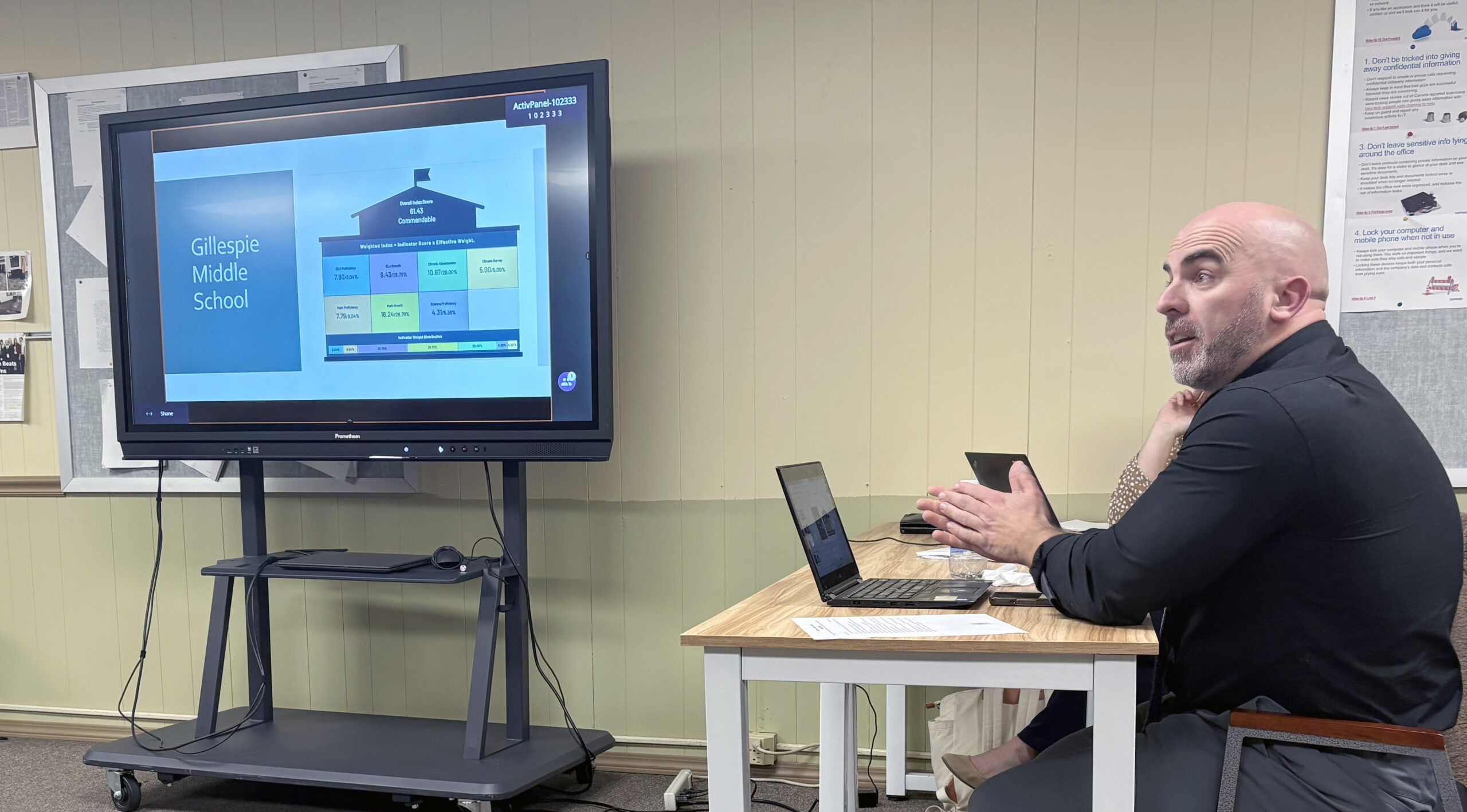
Members of the Community Unit School District 7 Board of Education on Monday night voted to approve a property tax levy request totaling $3,920,295 for 2025 property taxes payable in 2026. Because of tax caps and other factors, however, the district expects to collect only an estimated $3,786,607 of the requested amount.
In addition to acting on the tax levy, the board also held a lengthy discussion regarding annual district “report cards” issued by the Illinois State Board of Education to assess school performance from last year, approved a high school band/choir performance trip to Chicago in March, and agreed to apply for a school maintenance grant of up to $50,000 in matching funds.
The new proposed levy exceeds last year’s tax extension of $3,599,569 by more than $320,726—an increase of about nine percent if the levy were to be approved at the county level. The more realistic anticipation of $3,786,607 exceeds last year’s extension by $187,038, or an increase of about three percent. A Property Tax Extension Limitation Law (PTELL), approved by Macoupin County voters in 1995, restricts increases in the levy to five percent or the federal Consumer Price Index (CPI), whichever is less. This year’s CPI is estimated at 2.9 percent.
The approved levy seeks $1,650,000 for the Education Fund while expecting to realize $1,653,831; $450,229 for Operations & Maintenance, while anticipating $438,041; $200,000 for Transportation while expecting $180,434; $35,000 for Working Cash while expecting $42,602; $174,700 for the Illinois Municipal Retirement Fund while anticipating $117,788; $154,101 for Social Security while expecting $105, 248; $247,264 for Tort while anticipating $240,570; and $33,501 for Special Education while expecting $32,593. For Bond and Interest, which is not subject to PTELL, the district is levying $975,500 while anticipating the same amount.
Local property tax revenue accounts for about 20 percent of the district’s overall annual budget.
Because the levy request exceeds 105 percent of the previous year’s extension, a public hearing is required. That hearing is scheduled at the start of the board’s regular December meeting at 6 p.m., Monday, Dec. 15. In the meantime, the proposed levy is available for public inspection on the district’s website and in the district office.
Using a PowerPoint presentation, Owsley emphasized the levy request is essentially a wish list for what the district would like to raise through property taxes.
“The levy is the ‘Christmas list’ I talk about every year,” Owsley said. “If you don’t put it on the list, you’re not going to get it.”
Projecting what the district can legally seek under tax caps can be challenging because the district’s total equalized assessed valuation will not be confirmed until after Jan. 1 while state law requires the district to file its levy request before the end of December. For that reason, local school districts routinely file requests that exceed what they actually expect to receive in property tax revenue, and rely on the County Clerk to adjust the request to the maximum amount the district can receive.
“Because of tax caps, we have one shot to capture increases in the EAV and new construction,” Owsley said. “If we don’t do that, we lose it in perpetuity.”
To calculate the new levy, Owsley projected a 15.12 percent increase in the EAV—nearly double the previous year’s rate of increase. By overestimating the EAV growth, the district expects to capture the entire increase in assessed valuation when that number is finally determined.
“Even though we know the EAV will likely be around the historical average, we base our levy on a much higher amount so as not to lose revenue from new growth,” Owsley told the board. “We can do this without running the risk of overtaxing taxpayers because the district will receive no more than what we are entitled to by law.”
Owsley said relatively stable increases in EAV have resulted in a steadily declining tax rate. Since 2014 when the rate was $4.24 per $100 in EAV, the rate has fallen to $3.20 for 2024. In other words, the county can use a lower rate to generate the extension to which the district is entitled because the value of taxable property has increased.
“As long as the EAV goes up by more than the Consumer Price Index, our tax rates are going to go down,” Owsley noted.
SCHOOL DISTRICT REPORT CARDS
The board spent several minutes discussing recently released school report cards issued by the Illinois State Board of Education. Interested persons can view local report cards by visiting https://www.illinoisreportcard.com/.
All three attendance centers received a “Commendable” designation, meaning there are no student groups that are underperforming academically, and the high school graduation rate exceeds 67 percent. Last year, BenGil Elementary School achieved an “Exemplary” designation—the top designation a school can achieve.
Elementary Principal Angela Sandretto said administrators knew the school would not earn an Exemplary rating, even though students are state average in English/language arts, math and science. The Report Card designations are based on growth rather than academic performance. With students already exceeding state standards last year, the opportunity for growth was limited.
Assistant Principal Tara Cooper agreed, noting BenGil Elementary’s student performance is in the upper half of schools statewide that are meeting academic standards. “So, while we are not ‘Exemplary,’ we’re very happy with where we are.”
Supt. Owsley told the board the State Board of Education is working on revamping the assessment system because of the growth vs. performance issue. “That’s why they’re redoing all of this because they are penalizing schools for meeting goals,” he said.
For Gillespie Middle School, the report card shows students meeting or exceeding state averages in math and science but significantly lagging in English/language arts.
“ELA is our most concerning area,” Principal Patrick McGinthy told the board, “along with absenteeism.” The report card shows a chronic absenteeism rate of 25 percent, but Owsley and other administrators said the rate is exacerbated by the State Board of Education including nearly all absences whether or not they are excused.
Rosentreter noted the State Board will allow a student to be absent five days for illness without a doctor’s excuse. On the sixth day, however, the absence is unexcused unless the parent or guardian provides a doctor’s slip. Many parents, however, are reluctant to pay for a doctor’s visit for a child that is suffering from a minor illness.
McGinthy said Middle School teachers are attempting to address the deficiency in English/language arts by increasing writing exercises and requiring students to write in conjunction with other curriculum areas.
Rosentreter noted that the assessment standards for high schools differ from the standards for elementary and middle schools in that the State Board emphasizes graduation rates. For Gillespie, the graduation rate is an impressive 86 percent, though chronic absenteeism checks in at 31 percent.
“Math is definitely our shining star,” Rosentreter said, noting the school scored 17.8 points compared with the state average of 18. The school performed less well in the areas of English/language arts and science, scoring 16 points on ELA compared with the state score of 18 and 17.2 points compared with the state average of 19.
The report cards are based on results for the Illinois Assessment of Readiness (IAR) test for elementary and middle school students, and ACT scores for high school students.
Administrators said it’s difficult to motivate students to do well on state-mandated tests since the tests do not affect the student’s grade point average. To incentivize testing, Rosentreter said the high school is offering to let students skip final exams if they hit state standards on the mandated tests.
Owsley noted that the district report card documents the continuing decline in school enrollment—dropping from 1,325 seven years ago to 1,082 for the 2024-25 academic year.
“We don’t see that turning around anytime soon,” Owsley said. “It’s not just a Gillespie thing; it’s a trend for schools throughout Macoupin County.
BAND/CHOIR TRIP TO CHICAGO
Following a presentation by band/choir instructor Brad Taulbee, the board approved a high school band and choir performance tour to Chicago set for March 19-21. Taulbee said the tour company retained for the trip places emphasis on security and safety for traveling students. The company supplements hotel security with its own security personnel to monitor student rooms during the trip.
The tour includes workshop sessions at Vandercook College in downtown Chicago, and performances by the choir at the John Hancock Center and by the band at one of the city’s museums.
Taulbee said he is attempting to keep the cost affordable for participating students. Depending upon the number of students who ultimately go on the trip, he said he expects the cost to be about $739 per person. Additionally, he is lining up sponsors who can help with expenses for students who could not otherwise afford to participate.
“Security is my main concern,” said Board President Mark Hayes. “We just came back from there and seven people were shot in the area we were in.”
Taulbee said he expects to recruit seven to 10 chaperones and will ensure that the ratio of students to chaperones does not exceed 1:10.
SCHOOL MAINTENANCE GRANT
The board concurred with Supt. Owsley’s recommendation to again apply for a state School Maintenance grant of up to $50,000. The grant is a “matching” grant requiring the district to match grant funds dollar for dollar. The district has successfully applied for the grant for the past several years.
If the application is successful, Owsley said the funds will likely be used to remove asbestos-containing floor tiles in the choir room and elsewhere in the Middle School.
PERSONNEL
Following an executive session of about 40 minutes to discuss personnel and other issues, the board voted unanimously to accept the resignation of Tim Wargo as an assistant high school baseball coach and post the position as vacant, and voted to appoint Wargo as the head high school baseball coach for the coming season.
In separate actions, the board approved maternity leaves for Alexis Lupkey, district paraprofessional, and Gear-Up Coordinator Jordan Bartok. Lupkey’s leave is tentatively scheduled from Dec. 8 through March 18. Bartok’s leave is expected from Dec. 12 through Jan.6.
Board members voted unanimously to hire Christopher Whaley as a substitute bus driver, pending a routine background check and documentation of certification.
The board also voted unanimously to terminate Makayla Huff as a three-hour cook and post the position as vacant.

On a motion by Bill Carter, seconded by Weye Schmidt, the board voted unanimously to rehire fall coaches as follows: Jordan Bartok as head high school girls volleyball coach with Shelsie Price, as an assistant coach; Cory Bonstead as head football coach with Nate Henrichs, Jarrod Herron, Korben Clark, Alex Jasper, J.O. Kelly, Billy Gill and Florian Seferi as assistant and volunteer assistant coaches; Jay Weber as head coach for the parent-funded high school cross-country program with Jack Burns as a volunteer assistant coach; Jake Kellebrew as head coach for the parent-funded high school golf program, with Michael Otten as a volunteer assistant coach; Tim Wargo as head middle school baseball coach with Trae Wargo as assistant coach; Michelle Smith as head middle school softball coach with Jim Matesa, Joe Kelly and Melissa Heigert as assistant coaches; and Liz Thackery as head coach for the parent-funded middle school cross-country program with Laura Peterson as a volunteer assistant coach.
DISTRICT FOCUS
During a District Focus segment, Supt. Owsley introduced newly hired School Resource Officer Jacob Linhart, and High School Principal provided a report with photos of a recent school-wide Veterans Day observance.
Linhart, who has served five years as a police officer on the Gillespie Police Department, replaces Wade Hendricks, who recently retired after serving three years as the CUSD 7 School Resource Officer.
Linhart said it is a “great privilege” to serve as a Resource Officer, protecting students and staff. “I’m honored that you guys are allowing me to do it,” he said.
High School Principal Rosentreter said the school served breakfast to about 200 veterans and their families Tuesday morning, Nov. 11. Later, the veterans were joined by nearly 700 high school and middle school students for a recognition ceremony in the high school gymnasium.
Since the event coincided with the 25th anniversary of CUSD 7’s Wall of Honor program, the annual event did double duty as an induction ceremony for five are individuals, all of whom happened to be U.S. Military veterans.
The inductees included the late Sergeant Major John Marion Malnar, Command Sergeant Major John “Jack” Burns, Colonel Mark Daley, Lieutenant Colonel William P. Falke and Captain Robert Leone. Rosentreter said Daley and Leone traveled with their families from Colorado and Texas, respectively, to attend the ceremonies.
Burns, a retired CUSD 7 teacher, later visited BenGil Elementary School to present a program and teach students how to properly fold an American flag.
Rosentreter recognized the City of Gillespie for a donation of $1,000 to help purchase food for the veterans.
Born in Benld and a resident of Sawyerville, “Big John” Malnar earned a Silver Star during the Korean Conflict and a Gold Star, awarded posthumously after he was killed in action in 1968 in Vietnam. A Marine training center at Camp Geiger in North Carolina is named in his honor.
Though not a Wall of Honor inductee, Jacob Miller, a 100-year-old World War II veteran and recipient of two Purple Hearts, was recognized with a standing ovation.
The annual Veterans Day breakfast and ceremony provides students with an opportunity to meet and recognize local veterans as potential role models for their own futures.
Owsley said the event is a major event on the district’s calendar which grew out of a simple flagpole ceremony initiated 25 years ago.
CEJA GRANT FUNDS
Board members briefly discussed plans for about $74,000 in anticipated Climate and Equitable Jobs Act (CEJA) grant funds. The federal program is intended to compensate communities that have experienced revenue loss as a result of coal mine closures.
Owsley said the district committed about $86,000 in last year’s CEJA grant funds to the City of Gillespie to help pay for improvements to Plum Street, which is heavily used by district school buses. He has not transferred those funds, however, pending the start of the project.
Owsley said he was seeking the board’s input on how the money should be used.
“We could continue to partner with the city on Plum Street,” he said. “But there are plenty of project areas within the school.” The money could be used, for example, for continuing asbestos abatement. He identified other upcoming needs, including a new roof for the high school/middle school and an HVAC project.
President Hayes pointed out the school district paid for improvements to Kelly Street when BenGil Elementary was built and subsidized a project to reconfigure drainage on Broadway Street, in addition to the dollars committed for Plum Street.
“The school district is not in the business of building roads,” he said. “I think we’ve been more than generous with the city.”
Board member Peyton Bernot agreed the money should be committed for use by the school district.
TRIPLE I CONFERENCE
Several board members who attended a conference for board members and administrators Friday-Saturday, Nov. 21-23, in Chicago, commented briefly about their take-aways from conference sessions. Popularly known as the Triple I Conference, the convention is sponsored by the Illinois Association of School Boards, Illinois Association of School Administrators and the Illinois Association of School Business Officials.
Owsley said more than 700 Illinois school districts were represented, making the Triple I the largest gathering of education professionals in North America.
Bernot briefly reported on a session he attended regarding upcoming legislation and financial outlooks for school districts. He described the session as “much less optimistic” than sessions he’s attended in the past.
Owsley was among the convention presenters, discussing social-emotional learning. He commented that several districts attending reported efforts to involve students in school administrators. Some districts, he said, appointed a non-voting student representative to the school board to take part in discussions directly affecting students.
“When you think about it, we hear from faculty members and we hear from parents,” Hayes commented. “The people we don’t hear from are the most important part of what we do.”
Comments


Class of 2026 (Seniors)
High honor roll: Emily Bergen, Deshaunta Cooper Jackson, Marshall Garwood, Katherine Gerdes, Carson Hailstone, Jule Hansmann, Jersey Helvey, Lillianna Jones, Ava Parish, Kori Petersen, Ava Rakers, Sean Roach, Lucas Rosenthal, Luke Schuckenbrock, Brody Shaw, Carter Sies, Nevaeh Thomas, Hailey Young
Honor roll: Anthony Amoroso, Jacob Baglin, Ceanna Bearden, Mark Caselton, Edin Compton, Carson Cooper, Addison Cox, Jackson Crook, Brookelyn Crotchett, Brayden Enslow, Hank Fletcher, Collin Griffith, Madyson Grogg, Luna Gross, Hunter Hegel, Elin Herold, Roadie Jackson, Kayden Koelker, Kyle Kottman, Cedrick Krieder, Dawson Lancaster, Sophia Lewis, Aiden Manley, Jessalyn McElyea, Mylee Mckee, Dawson Morgan, Douglas Neverdowski, David Norville, Chaz Oberkfell, Tyler Palmer, Lukas Parish, Zachary Phillips, Makayla Price, Joseph Reid, Paxton Reid, Desiree Rife, Ava Segarra, Brock Sherman, Sadie Sholtis, Nathan Spencer, Carman Toprani, Brooklyn VanHuss, Kaia Vickery, Whelen Walker, Claire Wallace
Class of 2027 (Juniors)
High honor roll: Jack Bulla, Olivia Crumley, Emily Helvey, Cole Katich, Olivia Kelly, Tember Miller, Cheyenne Sarti
Honor roll: Zowe Badolato, Jaxon Ballinger, Logan Belcher, Clayton Bethard, Sloane Brawner, Wrigley Bruhn, Mitchell Clark, Keenin Compton, Lillian Conner, Riley Cox, Briley Flournoy, Margaret Heyen, Marli Johnson, Lucca Kapp, Zaden King, Isaac Kravanya, Michael Marcacci, Braxten Noll, Adam Peterson, Matthew Plovich, William Ranger Fleshman, Wesley Reiman, Cash Reynolds, Karlee Rhodes, Landon Ridenhour, Kolten Robbins Lasica, Alex Schoen, Laci Schuckenbrock, Emilia Segarra, Carter Segrest, Jasmine Smith, Cali Stagner, Emerson Striegel, Payten Taylor, Caleb Thompson, Amari Vickery, Aedan Watson, Macie Williams, Maxwell Young
Class of 2028 (Sophomores)
High honor roll: Cali Barkley, Scarlet Bruhn
Honor roll: Bryce Alpi, Gracelynn Balestri, Dallas Barker, Alexis Brown, Logan Buhs, Aleeyah Busch, Jasper Calcari, Ava Carr, Annabelle Daniels, Tegan Davis, Tess Dixon, Lyla Drewel, Madison Durston, Kylie Edge, Lainey Edwards, Floritza Garcia Santiago, Katie Hamann, Keegan Hartpence, Kullen Hartpence, Hadyn Hegel, Olivia Hitos Colino, Nolan Hostettler, Levi Hughes, Henry Knetzer, Sophie Knetzer, Cory Knotts, Paige Marcum, Noah Marks, Kyndall McElyea, Weston Melchert, Alexis Nalley, Preston Noe, Stephen Otten, Elijah Pabon, Urijah Pabon, Brianna Phillips, Benjamin Pruitt, Braden Reich, Caitlynn Rhodes, Nolan Ruyle, Alyssa Saathoff, Kendall Schweppe, Helaina Scott, Destini Smith, Gillian Smith, Aliana Snow, Xzavier Spencer, Rafe Stangle, Richetti Stewart, Bryce Stoecker, Addisyn Tallman, Madisyn Thomas, Ayden Vernish, Luke Walker, Matrix Wright, Carter Young
Class of 2029 (Freshmen)
High honor roll: Collins Hagan, Marlee Hebenstreit, Paige Swank
Honor roll: Alesana Adams, Ella Brawner, Audrina Burkel, Bryson Cox, Chyla Crainick, Rayne Crites, Joshua Crumley, Thodrick Dirks, Mariella Garrison, Rylee Geisler, Landyn Hagler, Owen Hammann, Kai Hampson, Regan Harbaugh, Isabella Harbour, Gavin Horner, Alexander Jacobs, Alex Johnson, Giana Kapp, Addeline Laflin, Izzabella Manus, Frank Montoro, Storm Moreland, Amaelie Patterson, Dominique Payne Jr., Benjamin Peterson, Lila Polach, Avianna Ranger Fleshman, Marxon Rolando, Dominic Savant, Jackson Schardan, Jacob Schuette, Kristina Schuette, Lyla Shaw, Holden Sies, Kelleigh Simmons, Hanley Stoecker, Addyson Strang, Graham Striegel, Jacob Walker, Payton Welch, Bryleigh Whaley, Cole Williamson, Sydney Wilson, Michael Yeager
Comments
Community News
School board accepts annual financial report, chooses property/liability insurance policy

Members of the Community Unit School District 7 Board of Education on Monday night voted unanimously to accept the district’s annual financial report, chose an insurance carrier for property and liability, and authorized the Superintendent to apply for an administrative expenditures waiver.
Following a lengthy executive session, the board also voted 4-1 to expel an elementary student for the remainder of the school year, one of the youngest students the board has ever cited for expulsion. Board member Peyton Bernot cast the sole negative vote. Board members Amanda Ross, Dennis Tiburzi, Kelli Vesper and Weye Schmidt all voted to approve the disciplinary action. Board member Bill Carter was absent. There are no alternative school programs for students below the sixth grade. The expelled student reportedly will have an opportunity to continue classwork via an online program and will be provided with access to school counseling services.
Ken Loy, an accountant with Loy-Miller-Talley Public Accountants, Alton, told board members that the annual audit resulted in a “clean, unmodified” opinion from the auditors, meaning there were no descrepancies in the district’s accounting procedures for the fiscal year that ended June 30. The audit, which is required by state law, contains three opinion letters, all of which were positive in regard to the district’s accounting and fiscal management.
One letter is a general report of the auditors’ findings, indicating the district’s financial records “present fairly, in all material aspects, the assets and liabilities arising from cash transactions of balances of each fund.” Further, the report affirms, “the revenues (the district) received and expenditures it paid for the year . . . (are) in accordance with provisions of the State Board of Education.”
A second letter describes the scope of the auditing process, while a third letter addresses the district’s handling of federal funds. Loy said the federal letter is required when a district receives more than $750,000 in federal funds. For the most recent fiscal year, the district received about $2.5 million from federal sources. While that revenue triggered the need for a separate opinion letter, Loy said the amount was down somewhat from the past few years when the district was receiving COVID recovery funds. As with the general letter, the federal report reflects “a good, clean audit report,” according to Loy.
“All of these opinion letters are good as they have been in the past,” Loy said.
Zeroing in on some details of the 75-page audit, Loy noted that all funds ended the fiscal year in the black, except for the Illinois Municipal Retirement Fund which spent about $33,000 more than it received in revenue. However, Loy said, that deficit was a planned deficit that drew down on surplus balances.
“All of your other funds were positive,” he noted.
The district’s total equalized assessment value, the basis for property tax extensions, increased to $112,324,042 from $103,564,334 a year earlier, which was up from $95,324,343. The property tax extension for 2024, payable in 2025, was $3,599,569. The board typically sets the levy for the upcoming tax year in December.
The per capita tuition charge, determined by dividing enrollment into the total cost of education, increased from $8,892 for fiscal 2024 to $13,248 for fiscal 2025—due, in part, to a dramatic decrease in enrollment. The report notes that enrollment dropped from 1,005 in 2024 to 871 in 2025. That decline in enrollment, according to Loy, resulted in about $2,000 of the increased tuition charge.
Loy said the enrollment erosion is not unusual in downstate school districts.
“Our rural communities are aging,” he said. “We don’t have the size of families we used to have.”
Loy noted that the district’s state financial profile score increased from 3.7 out of 4.0 for fiscal 2024 to 3.8 for the most recently concluded fiscal year. The score identifies the district as a “Recognition Status” district, the highest ranking for financial health and stability.
“Your score went up a little bit because your debt went down,” Loy said. “At the same time, your capacity to borrow went up.”
Of the four criteria the State Board of Education uses to determine the score, CUSD 7 fell short of a 4.0 score in only the area of debt to income ratio.
“If not for the substantial debt, you would have had a perfect score,” Loy noted.
Supt. Shane Owsley told the board that some of the debt that’s bringing down the district’s financial score is lingering debt associated with the loss of Benld Elementary School and the construction of the BenGil Elementary School. The district secured special state legislation allowing it to exceed its normal debt ceiling to deal with the mine subsidence crisis. While that debt does not count toward the district’s debt ceiling, it is included in the financial report.

“Overall, you had a good year financially,” Loy said. With a $1.8 million increase in cash and investment balances “you are on solid footing and keeping up with inflation.”
INSURANCE POLICY
After several minutes of discussion, the board opted to switch from Wright Specialty to the Illinois Counties Risk Management Trust to provide property and liability insurance coverage at a cost of $235,061—about 26 percent less than what the district paid in premiums last year to Wright Specialty.
Richard Sedlak, an insurance broker with Schmale Insurance Agency, Belleville presented two options for the board to consider and discussed some of the advantages of one over the other. Wright Specialty proposed a policy similar to what the district currently has, except that the deductible for wind and hail damage was increased from one percent to two percent.
“A two percent deductible for wind and hail on three buildings could be a lot of money,” Owsley advised the board.
Wright’s proposed premium was $318,852—an increase of about 12 percent over what the district paid to Wright last year.
Wright also fell short on mine subsidence coverage, setting a claim limit of $750,000, compared with ICRMT’s limit of $10 million. The Trust also offered replacement costs on roofs up to 20 years in age. Wright’s coverage for earthquake damage topped out at $15 million, compared with ICRMT’s $10 million limit.
“If your concern is with earthquakes, Wright has the better program,” Seldom said. “If you’re more concerned about mine subsidence, the Trust has a better program.”
Sedlak said ICRMT is a stable company that has been in business more than 30 years. “It’s a non-accessible trust,” he said, meaning that if the company experiences a large loss, it cannot come back and reassess policy holders.
Going with ICRMT, Sedlak said, would give the district up to $30 million in coverage on the high school/middle school.
“This will be the first time you’ll have coverage that equals the value of that building,” he said. By going with the Trust, he said, “You’ll be giving up a little earthquake coverage for a lot more subsidence coverage.”
Later in the meeting, the board voted unanimously to approve ICRMT’s proposal for the coming year. The proposal includes Workers Compensation coverage through Zenith Insurance Co., the district’s current Workers Compensation carrier.
BUS PURCHASE
On a motion by Peyton Bernot, seconded by Amanda Ross, the board unanimously accepted Supt. Owsley’s recommendation to spend upward of $153,000 for a new bus from Central States Bus Sales to replace an older bus from the district’s fleet of buses. Owsley said he will pay for the vehicle from the Transportation Fund which was projected to end the year with a surplus of about $564,000. Financing the purchase, he said, would unnecessarily cost the district about six percent in interest.
“My goal is to make sure that none of our buses are more than five years old,” he said, “because that’s when depreciation ends.”
The fleet currently consists of 13 buses, seven of which are older than five years.
“We don’t need 13 buses,” Owsley said, reporting that Transportation Director Tim Besserman said he’d be comfortable with 10 buses. The district currently runs seven full bus routes.
Owsley said two buses already have been surplused, and he expects to surplus two more inoperable buses soon. The surplused vehicles are being scrapped, he said, “because scrap prices right now are more than what we can get for trade-in.”
ADMINISTRATIVE COSTS WAIVER
Following a mandated public hearing, the board approved a resolution directing the Superintendent to apply to the State Board of Education for a waiver freeing the district from keeping increases in administrative costs at five percent or less. ISBE requires a waiver whenever administrative cost increases exceed five percent. Owsley said those costs for this fiscal year are likely to increase by eight percent.

The resolution applies solely to administrative costs that fall under the Superintendent’s office. Owsley said the increased costs are attributable to mandated increases in staff salaries and increasing costs for supplies.
As part of the process, the district was required to notify the Macoupin County Federation of Teachers Local 528, along with state legislators representing the district.
PERSONNEL
The board accepted the resignation of Jennifer Brown as the high school Student Council sponsor, effective at the end of the current school year, after several years of serving in that position.
“She’s been the Student Council sponsor for a lot of years,” Bernot noted. “She was the sponsor when I was in school.”
The measure to accept her resignation also directs the district to post the position as vacant.
Board members also voted unanimously to accept the resignation of Jake Kellebrew as the district’s Bass Fishing coach and to post the position as vacant.
The resignation of Jeremy Smith as high school head baseball coach was also accepted after 16 successful seasons with the team.
DISTRICT FOCUS
During a District Focus segment, Elementary Principal Angela Sandretto introduced new teachers Nick Davio, who teaches music and fifth-grade band, and speech instructor Karen Robertson.
“Students are very excited to be in his classes,” Sandretto said of Davio. “We’re very happy to have him.”
She said the district is “very lucky” have Robertson, whom she described as a “great addition to the elementary staff.”
High School Principal Jill Rosentreter noted newly hired paraprofessionals, Shari Scott and Foli Seferi, along with newly hired custodian Tom Turiglatto. Rosentreter described the paraprofessionals as “self starters.”
GRANTS
Owsley reported the district recently received a $20,000 grant from the Illinois Arts Council to buy equipment for the high school art classroom. He also reported a $15,000 donation from Dr. Ross Billiter, and the receipt of a $50,000 matching grant for facility improvements.
Owsley singled out the administrative staff for praise following the conclusion of Principals Appreciation Week.
“I’d take my team over any other team in the state,” he said. “I can’t thank them enough. They’re here everyday and they care about every student in the district.”
“We have not had a Superintendent who has brought the amount of grant money into our district as you have,” Board President Mark Hayes told Owsley.
OTHER ACTION
In other action, the board approved moving the regular monthly board meeting for December from Monday, Dec. 22, to Monday, Dec. 15, to preclude conflicting with the holidays and winter break.


