

Community News
From the Librarian’s desk by Steve Joyce


While rummaging through some articles at the Coal Museum, I came across one that struck my fancy. It was from the Illinois State Journal and the Headline was, “Miners, anarchists, soldiers combine for tense faceoff.” The date was March 21, 1911. I decided to follow up on the story and see what other newspapers had to say. I was shocked by the headlines around the U.S., splashing the controversy. Some of the headlines were as follows:
“1,000 armed foreigners parade streets of town.”—Knoxville, TN Sentinel
“Immigrant coal miners terrorize Illinois town, driving Americans before them with guns.” —Chattanooga, TN News
“Armed foreigners drive miners from work in Gillespie.”—Birmingham, AL News
“Armed foreigners arm for battle.”—Spokane, WA Chronicle
“One Thousand on the march.”—Wilmington, DE News Journal
“Foreigners demonstrate.”—Salt Lake City, UT Deseret News
“Foreigners at Benld are ugly”—Bloomington, IL Pantagraph
There were major news stories across the country, north, south, east and west. Major cities carried the stories from Boston to San Francisco and Bismarck to Waco, Texas. The stories were inflammatory and struck an opinion that our area had radical, troublemakers working in the mines.
Throughout the country these headlines made people fear that the foreign miners were anarchists and armed mobs. Most of the stories were somewhat exaggerated although there were protests, marches, armed miners and troops. The Gillespie News, while other national newspapers highlighted the situation, played it down as an over-zealous protest, stirred up by “yellow journalism.”
Here are the facts that brought about this national uproar.
Coal production in Illinois is in the decline, salaries are slipping and the mines are cutting back on working days, sometimes only two to three days a week. Many foreigner miners see this as a threat to their livelihood. The Superior Mines employ around 1,850 men. When working, salaries are around $80 a month. The Illinois State Legislature was informed that 20,000 Illinois miners were idle in March and this produced hardship on the miners. A mild winter and mechanization were causes of this problem.
Superior Coal Company decided to add another machine in Mine #2 in Sawyerville and the United Mine Workers Union supported the move. Machines for the past two years were being placed in the Sawyerville mine. Most of the workers were foreign Italians from Benld and thought this was cutting into their work opportunities. The miners retaliated by cutting back on their mining quotas. Miners were fired. Because of this, the miners refused to work. All three of the Superior mines were shut down by Superior Coal Co. for a couple of days. The situation between the company and the foreign miners did not change. The miners stayed on strike.
The state officials of the UMW ordered the miners of all three UMW Locals to go back to work or be subject to fines because the striking miners violated the union agreement and constitution. A large miner meeting of all three locals met in Gillespie and informed the striking miners of the decision of the UMW. Gillespie also had the Superior Coal offices.
Most of the American miners were willing to go back to work, however Macoupin County Sheriff Etter anticipating trouble from the foreigners called out deputies to patrol Mine #1 in Eagarville. On Monday March 20, 1911, approximately 250 armed miners prevented other miners from going to work at the Eagerville mine. Etter’s deputies were out-numbered. Fearing that this could escalate Etter asked for state troops. Governor Deneen ordered 10 companies of militia to Gillespie on Tuesday, March 21.
Here is where the newspaper headlines took their information.
Prior to arrival of troops on Tuesday morning, approximately 700 armed foreigners, mostly miners marched from Benld to Eagarville to Gillespie and back to Benld through Mt. Clare Mine #3.
The Springfield State Journal called this march as follows, “Strikers from Benld marched into Gillespie this morning, making a show of arms, with a numerical strength that paralyzed the lovers of peace. The red flag of anarchy floated proudly at the head of the procession.”
The impression by Gillespie residents, who being alarmed, was that they were being attacked by an armed mob. However, there was no conflict or trouble and 350 National Guardsmen set up camp in Benld to stop any potential rioting, while only one company of troops were stationed in Gillespie. The troops stayed in camp for about one week.

The Gillespie News publisher S P Preston took a very dim view of the incident and condemned the miners always referring to them as foreigners preventing American union miners from doing their work. But there was no condemnation of the town of Benld. The outcry in the Gillespie paper was far toned-down to those throughout the U.S. There were no headlines. There were not a thousand marchers, there was no trouble but newspapers cried out that the foreign miners were an armed mob looking for trouble.
To compound the situation, several citizens received “black hand” letters. These letters threatened death. The “Black Hand” was an Italian community extortion organization threating violence, usually found in large eastern cities.
The three Superior mines remained closed temporarily. In early April the three locals of Eagerville, Sawyerville and Mt Clare all eventually returned to work and the strike ended after four weeks. The decision by local miners was not unanimous to return to work, but in the end all three union locals ended their strike.
This exaggerated reporting was not unusual throughout the U.S. Unionism and strikes were making big headlines. As an example, in March 1910 a major coal strike in Pennsylvania lasted for over a year involving 15,000 miners known as the Slovak Strike because 70% of the strikers were foreigners. Combine the fact that many unionists were both American-born and foreigners, it was the foreigners that were blamed for the trouble. But because of these unions, both American and foreign born, laws are being made by legislatures to protect the worker.
It is unfortunate that at the time of this mine strike on March 25, 1911, the famous Triangle Shirtwaist Fire in NYC occurred causing the death of 150 factory workers bringing an uproar about conditions of the American worker.
Comments










Ye Olde Christmas is the theme of the Macoupin County Historical Society’s annual Christmas Show, which will be held Friday through Sunday, December 5–7, at the John C. Anderson Home and Museum, 920 West Breckenridge in Carlinville.
“The Christmas Show is one of the most magical times to visit the Anderson Home,” said MCHS Board Member and House Manager Brandy England. “Some families make it an annual Christmas tradition to visit the Anderson Home when it is decorated for Christmas. It’s a great opportunity to get into the Christmas spirit and pick up some ideas for decorating your own home for the holidays.”
MCHS member Kendra Mize, of Bunker Hill, who has coordinated the decorating effort for more than two decades, has again marshalled a small army of volunteers to decorate all 13 rooms of the home. Each room features a themed Christmas tree, along with mantle pieces, centerpieces, tabletop decor, garlands and florals, and other special touches.
The home will be open for self-guided tours from 4 p.m. to 9 p.m. on Friday, December 5; from 9 a.m. to 9 p.m. on Saturday, December 6; and from 10 a.m. to 3 p.m. on Sunday, December 7.
“We’re very excited to offer for the first time candlelight tours from 6 p.m. to 9 p.m. on Friday and Saturday,” said Shawna Ashby, who serves as a co-manager with England. “Viewing the decorated home by candlelight promises to be a magical experience.”
The final candlelight tours on Friday and Saturday start at 7:30 p.m. Admission to the home is five dollars for adults and one dollar for children ages five to 12, with four-year-olds and younger admitted free of charge.
The Anderson Home Gift Shop will be open during tour hours, offering one-of-a-kind gift items and stocking stuffers. Santa Claus will be on hand in the downstairs parlor to greet children and listen to their Christmas wishes from 1 p.m. to 4 p.m. on Saturday, December 6.
While the decorated home is the centerpiece of the Christmas Show, several other features on the Historical Society’s grounds will be open. The Red Barn will be open and serving hearty beef stew, chili, homemade pies, and warming holiday beverages such as wassail and hot chocolate on Friday and Saturday.
The General Store and Print Shop will be decorated and open to the public, with the Print Shop offering its popular handmade Christmas cards and other items produced in the shop; kids can print their own blank “Santa List” to keep track of their Christmas wishes.
“The General Store offers unique gift items, including some small antiques, for shoppers to peruse,” England noted.
Local blacksmiths will demonstrate their craft in the MCHS Blacksmith Shop located on the north side of the Historical Society Grounds, with wrought iron gift items, including stocking hooks and decorative pieces, available for purchase.
The Macoupin County Historical Society’s Christmas Show runs concurrently with the Carlinville Christmas Market and Downtown Christmas events, and a free trolley and shuttle buses include the Anderson Home as a regular stop during the festivals, enabling visitors to ride from the square or the Macoupin County Fairgrounds to the Historical Society grounds.
Comments

Members of the Community Unit School District 7 Board of Education on Monday night voted to approve a property tax levy request totaling $3,920,295 for 2025 property taxes payable in 2026. Because of tax caps and other factors, however, the district expects to collect only an estimated $3,786,607 of the requested amount.
In addition to acting on the tax levy, the board also held a lengthy discussion regarding annual district “report cards” issued by the Illinois State Board of Education to assess school performance from last year, approved a high school band/choir performance trip to Chicago in March, and agreed to apply for a school maintenance grant of up to $50,000 in matching funds.
The new proposed levy exceeds last year’s tax extension of $3,599,569 by more than $320,726—an increase of about nine percent if the levy were to be approved at the county level. The more realistic anticipation of $3,786,607 exceeds last year’s extension by $187,038, or an increase of about three percent. A Property Tax Extension Limitation Law (PTELL), approved by Macoupin County voters in 1995, restricts increases in the levy to five percent or the federal Consumer Price Index (CPI), whichever is less. This year’s CPI is estimated at 2.9 percent.
The approved levy seeks $1,650,000 for the Education Fund while expecting to realize $1,653,831; $450,229 for Operations & Maintenance, while anticipating $438,041; $200,000 for Transportation while expecting $180,434; $35,000 for Working Cash while expecting $42,602; $174,700 for the Illinois Municipal Retirement Fund while anticipating $117,788; $154,101 for Social Security while expecting $105, 248; $247,264 for Tort while anticipating $240,570; and $33,501 for Special Education while expecting $32,593. For Bond and Interest, which is not subject to PTELL, the district is levying $975,500 while anticipating the same amount.
Local property tax revenue accounts for about 20 percent of the district’s overall annual budget.
Because the levy request exceeds 105 percent of the previous year’s extension, a public hearing is required. That hearing is scheduled at the start of the board’s regular December meeting at 6 p.m., Monday, Dec. 15. In the meantime, the proposed levy is available for public inspection on the district’s website and in the district office.
Using a PowerPoint presentation, Owsley emphasized the levy request is essentially a wish list for what the district would like to raise through property taxes.
“The levy is the ‘Christmas list’ I talk about every year,” Owsley said. “If you don’t put it on the list, you’re not going to get it.”
Projecting what the district can legally seek under tax caps can be challenging because the district’s total equalized assessed valuation will not be confirmed until after Jan. 1 while state law requires the district to file its levy request before the end of December. For that reason, local school districts routinely file requests that exceed what they actually expect to receive in property tax revenue, and rely on the County Clerk to adjust the request to the maximum amount the district can receive.
“Because of tax caps, we have one shot to capture increases in the EAV and new construction,” Owsley said. “If we don’t do that, we lose it in perpetuity.”
To calculate the new levy, Owsley projected a 15.12 percent increase in the EAV—nearly double the previous year’s rate of increase. By overestimating the EAV growth, the district expects to capture the entire increase in assessed valuation when that number is finally determined.
“Even though we know the EAV will likely be around the historical average, we base our levy on a much higher amount so as not to lose revenue from new growth,” Owsley told the board. “We can do this without running the risk of overtaxing taxpayers because the district will receive no more than what we are entitled to by law.”
Owsley said relatively stable increases in EAV have resulted in a steadily declining tax rate. Since 2014 when the rate was $4.24 per $100 in EAV, the rate has fallen to $3.20 for 2024. In other words, the county can use a lower rate to generate the extension to which the district is entitled because the value of taxable property has increased.
“As long as the EAV goes up by more than the Consumer Price Index, our tax rates are going to go down,” Owsley noted.
SCHOOL DISTRICT REPORT CARDS
The board spent several minutes discussing recently released school report cards issued by the Illinois State Board of Education. Interested persons can view local report cards by visiting https://www.illinoisreportcard.com/.
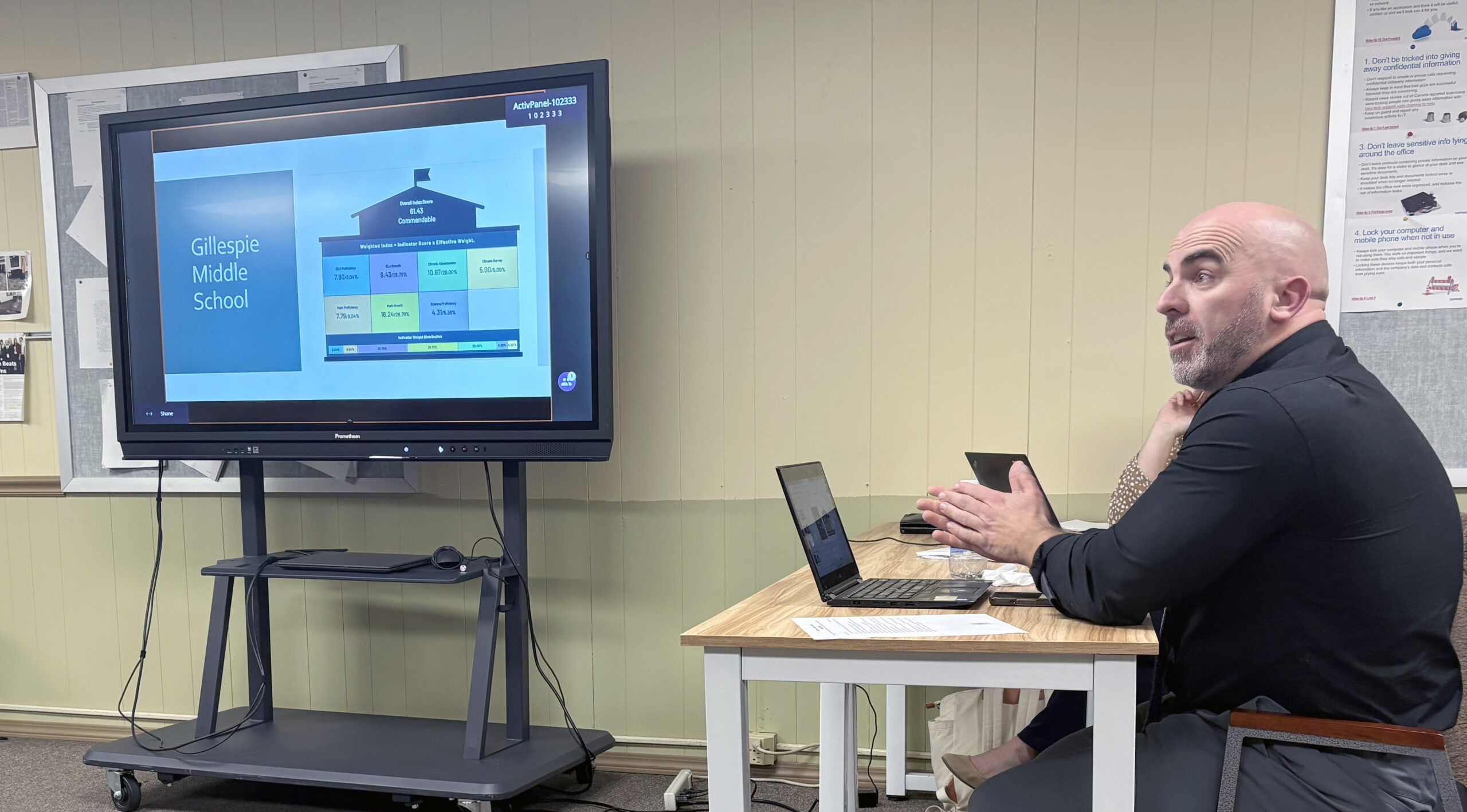
All three attendance centers received a “Commendable” designation, meaning there are no student groups that are underperforming academically, and the high school graduation rate exceeds 67 percent. Last year, BenGil Elementary School achieved an “Exemplary” designation—the top designation a school can achieve.
Elementary Principal Angela Sandretto said administrators knew the school would not earn an Exemplary rating, even though students are state average in English/language arts, math and science. The Report Card designations are based on growth rather than academic performance. With students already exceeding state standards last year, the opportunity for growth was limited.
Assistant Principal Tara Cooper agreed, noting BenGil Elementary’s student performance is in the upper half of schools statewide that are meeting academic standards. “So, while we are not ‘Exemplary,’ we’re very happy with where we are.”
Supt. Owsley told the board the State Board of Education is working on revamping the assessment system because of the growth vs. performance issue. “That’s why they’re redoing all of this because they are penalizing schools for meeting goals,” he said.
For Gillespie Middle School, the report card shows students meeting or exceeding state averages in math and science but significantly lagging in English/language arts.
“ELA is our most concerning area,” Principal Patrick McGinthy told the board, “along with absenteeism.” The report card shows a chronic absenteeism rate of 25 percent, but Owsley and other administrators said the rate is exacerbated by the State Board of Education including nearly all absences whether or not they are excused.
Rosentreter noted the State Board will allow a student to be absent five days for illness without a doctor’s excuse. On the sixth day, however, the absence is unexcused unless the parent or guardian provides a doctor’s slip. Many parents, however, are reluctant to pay for a doctor’s visit for a child that is suffering from a minor illness.
McGinthy said Middle School teachers are attempting to address the deficiency in English/language arts by increasing writing exercises and requiring students to write in conjunction with other curriculum areas.
Rosentreter noted that the assessment standards for high schools differ from the standards for elementary and middle schools in that the State Board emphasizes graduation rates. For Gillespie, the graduation rate is an impressive 86 percent, though chronic absenteeism checks in at 31 percent.
“Math is definitely our shining star,” Rosentreter said, noting the school scored 17.8 points compared with the state average of 18. The school performed less well in the areas of English/language arts and science, scoring 16 points on ELA compared with the state score of 18 and 17.2 points compared with the state average of 19.
The report cards are based on results for the Illinois Assessment of Readiness (IAR) test for elementary and middle school students, and ACT scores for high school students.
Administrators said it’s difficult to motivate students to do well on state-mandated tests since the tests do not affect the student’s grade point average. To incentivize testing, Rosentreter said the high school is offering to let students skip final exams if they hit state standards on the mandated tests.
Owsley noted that the district report card documents the continuing decline in school enrollment—dropping from 1,325 seven years ago to 1,082 for the 2024-25 academic year.
“We don’t see that turning around anytime soon,” Owsley said. “It’s not just a Gillespie thing; it’s a trend for schools throughout Macoupin County.
BAND/CHOIR TRIP TO CHICAGO
Following a presentation by band/choir instructor Brad Taulbee, the board approved a high school band and choir performance tour to Chicago set for March 19-21. Taulbee said the tour company retained for the trip places emphasis on security and safety for traveling students. The company supplements hotel security with its own security personnel to monitor student rooms during the trip.
The tour includes workshop sessions at Vandercook College in downtown Chicago, and performances by the choir at the John Hancock Center and by the band at one of the city’s museums.
Taulbee said he is attempting to keep the cost affordable for participating students. Depending upon the number of students who ultimately go on the trip, he said he expects the cost to be about $739 per person. Additionally, he is lining up sponsors who can help with expenses for students who could not otherwise afford to participate.
“Security is my main concern,” said Board President Mark Hayes. “We just came back from there and seven people were shot in the area we were in.”
Taulbee said he expects to recruit seven to 10 chaperones and will ensure that the ratio of students to chaperones does not exceed 1:10.
SCHOOL MAINTENANCE GRANT
The board concurred with Supt. Owsley’s recommendation to again apply for a state School Maintenance grant of up to $50,000. The grant is a “matching” grant requiring the district to match grant funds dollar for dollar. The district has successfully applied for the grant for the past several years.
If the application is successful, Owsley said the funds will likely be used to remove asbestos-containing floor tiles in the choir room and elsewhere in the Middle School.
PERSONNEL
Following an executive session of about 40 minutes to discuss personnel and other issues, the board voted unanimously to accept the resignation of Tim Wargo as an assistant high school baseball coach and post the position as vacant, and voted to appoint Wargo as the head high school baseball coach for the coming season.
In separate actions, the board approved maternity leaves for Alexis Lupkey, district paraprofessional, and Gear-Up Coordinator Jordan Bartok. Lupkey’s leave is tentatively scheduled from Dec. 8 through March 18. Bartok’s leave is expected from Dec. 12 through Jan.6.
Board members voted unanimously to hire Christopher Whaley as a substitute bus driver, pending a routine background check and documentation of certification.
The board also voted unanimously to terminate Makayla Huff as a three-hour cook and post the position as vacant.
On a motion by Bill Carter, seconded by Weye Schmidt, the board voted unanimously to rehire fall coaches as follows: Jordan Bartok as head high school girls volleyball coach with Shelsie Price, as an assistant coach; Cory Bonstead as head football coach with Nate Henrichs, Jarrod Herron, Korben Clark, Alex Jasper, J.O. Kelly, Billy Gill and Florian Seferi as assistant and volunteer assistant coaches; Jay Weber as head coach for the parent-funded high school cross-country program with Jack Burns as a volunteer assistant coach; Jake Kellebrew as head coach for the parent-funded high school golf program, with Michael Otten as a volunteer assistant coach; Tim Wargo as head middle school baseball coach with Trae Wargo as assistant coach; Michelle Smith as head middle school softball coach with Jim Matesa, Joe Kelly and Melissa Heigert as assistant coaches; and Liz Thackery as head coach for the parent-funded middle school cross-country program with Laura Peterson as a volunteer assistant coach.
DISTRICT FOCUS
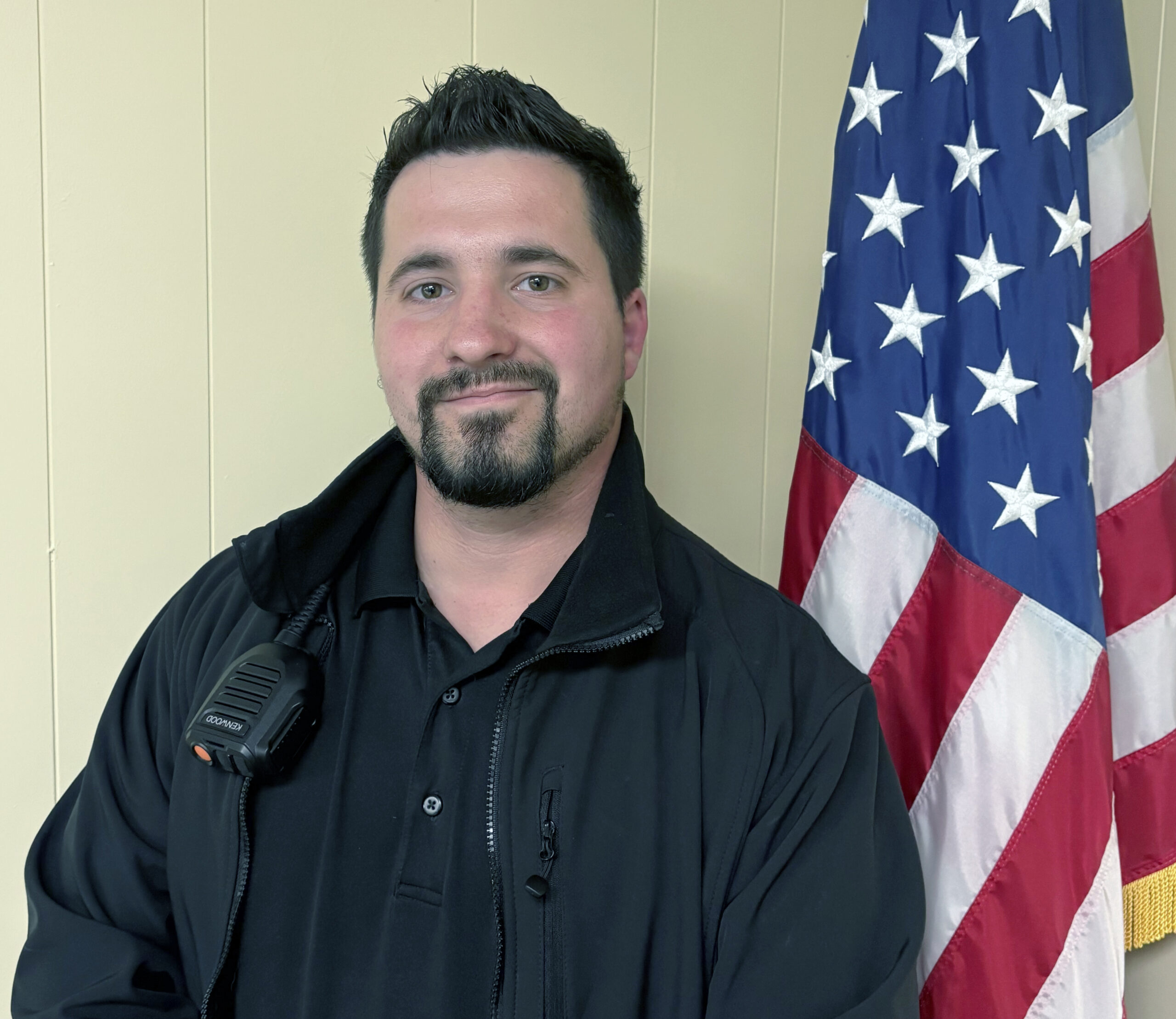
During a District Focus segment, Supt. Owsley introduced newly hired School Resource Officer Jacob Linhart, and High School Principal provided a report with photos of a recent school-wide Veterans Day observance.
Linhart, who has served five years as a police officer on the Gillespie Police Department, replaces Wade Hendricks, who recently retired after serving three years as the CUSD 7 School Resource Officer.
Linhart said it is a “great privilege” to serve as a Resource Officer, protecting students and staff. “I’m honored that you guys are allowing me to do it,” he said.
High School Principal Rosentreter said the school served breakfast to about 200 veterans and their families Tuesday morning, Nov. 11. Later, the veterans were joined by nearly 700 high school and middle school students for a recognition ceremony in the high school gymnasium.
Since the event coincided with the 25th anniversary of CUSD 7’s Wall of Honor program, the annual event did double duty as an induction ceremony for five are individuals, all of whom happened to be U.S. Military veterans.
The inductees included the late Sergeant Major John Marion Malnar, Command Sergeant Major John “Jack” Burns, Colonel Mark Daley, Lieutenant Colonel William P. Falke and Captain Robert Leone. Rosentreter said Daley and Leone traveled with their families from Colorado and Texas, respectively, to attend the ceremonies.
Burns, a retired CUSD 7 teacher, later visited BenGil Elementary School to present a program and teach students how to properly fold an American flag.
Rosentreter recognized the City of Gillespie for a donation of $1,000 to help purchase food for the veterans.
Born in Benld and a resident of Sawyerville, “Big John” Malnar earned a Silver Star during the Korean Conflict and a Gold Star, awarded posthumously after he was killed in action in 1968 in Vietnam. A Marine training center at Camp Geiger in North Carolina is named in his honor.
Though not a Wall of Honor inductee, Jacob Miller, a 100-year-old World War II veteran and recipient of two Purple Hearts, was recognized with a standing ovation.
The annual Veterans Day breakfast and ceremony provides students with an opportunity to meet and recognize local veterans as potential role models for their own futures.
Owsley said the event is a major event on the district’s calendar which grew out of a simple flagpole ceremony initiated 25 years ago.
CEJA GRANT FUNDS
Board members briefly discussed plans for about $74,000 in anticipated Climate and Equitable Jobs Act (CEJA) grant funds. The federal program is intended to compensate communities that have experienced revenue loss as a result of coal mine closures.
Owsley said the district committed about $86,000 in last year’s CEJA grant funds to the City of Gillespie to help pay for improvements to Plum Street, which is heavily used by district school buses. He has not transferred those funds, however, pending the start of the project.
Owsley said he was seeking the board’s input on how the money should be used.
“We could continue to partner with the city on Plum Street,” he said. “But there are plenty of project areas within the school.” The money could be used, for example, for continuing asbestos abatement. He identified other upcoming needs, including a new roof for the high school/middle school and an HVAC project.
President Hayes pointed out the school district paid for improvements to Kelly Street when BenGil Elementary was built and subsidized a project to reconfigure drainage on Broadway Street, in addition to the dollars committed for Plum Street.
“The school district is not in the business of building roads,” he said. “I think we’ve been more than generous with the city.”
Board member Peyton Bernot agreed the money should be committed for use by the school district.
TRIPLE I CONFERENCE
Several board members who attended a conference for board members and administrators Friday-Saturday, Nov. 21-23, in Chicago, commented briefly about their take-aways from conference sessions. Popularly known as the Triple I Conference, the convention is sponsored by the Illinois Association of School Boards, Illinois Association of School Administrators and the Illinois Association of School Business Officials.
Owsley said more than 700 Illinois school districts were represented, making the Triple I the largest gathering of education professionals in North America.
Bernot briefly reported on a session he attended regarding upcoming legislation and financial outlooks for school districts. He described the session as “much less optimistic” than sessions he’s attended in the past.
Owsley was among the convention presenters, discussing social-emotional learning. He commented that several districts attending reported efforts to involve students in school administrators. Some districts, he said, appointed a non-voting student representative to the school board to take part in discussions directly affecting students.
“When you think about it, we hear from faculty members and we hear from parents,” Hayes commented. “The people we don’t hear from are the most important part of what we do.”
Comments
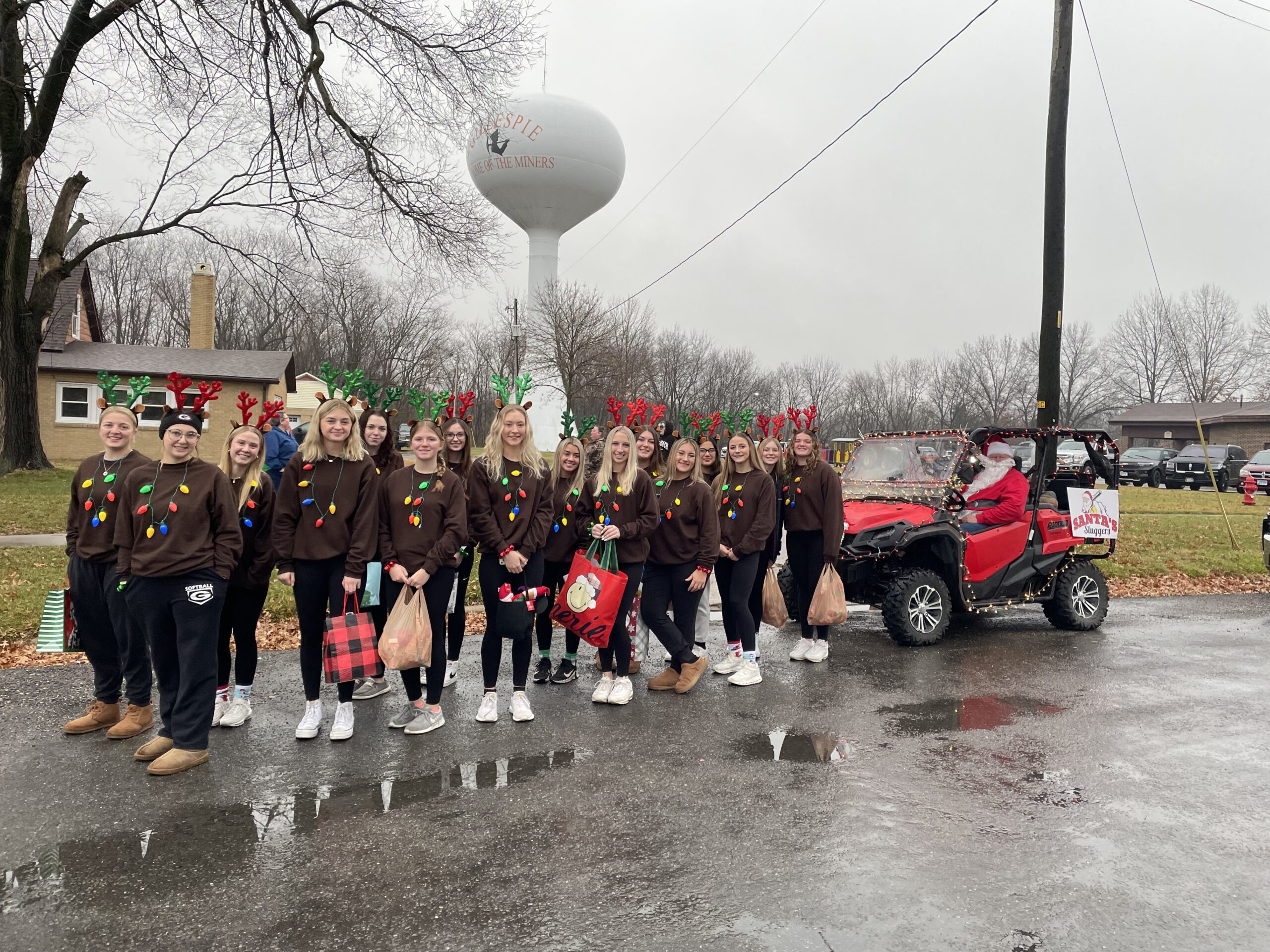
The Holiday Sparkle Committee of Gillespie is preparing for the 4th Annual Holiday Sparkle Lighted Parade and Community Tree Lighting, set for Sunday, November 30, at 6:00 p.m. in downtown Gillespie. This beloved community tradition invites residents and visitors to kick off the holiday season with lights, music, and festive cheer.
Food trucks will line the parade route starting at 4:00 p.m., offering a variety of tasty options for families to enjoy before and during the celebration. The event will culminate in the illuminated parade and the ceremonial lighting of the community tree, signaling the official start of the season’s celebrations.
A highlight of this year’s festivities will be a special performance by Gillespie area students in grades 3 through 5. The group will join together to sing Christmas carols, lending their voices to the town’s joyous welcome to the holidays.
Parade participants are invited to bring extra sparkle to the evening—whether by entering a parade float, walking in the parade, or simply attending to enjoy the atmosphere. Participation helps make the event truly magical for the entire community. The only requirement for the parade is all entries have to incorporate holiday lighting.
To join the parade lineup, interested participants can sign up at https://forms.gle/L7Q4tEkgjj8Lt5E47. The Holiday Sparkle Committee expresses gratitude for the ongoing support of residents, businesses, and volunteers who help bring this festive occasion to life each year.
The second part of the holiday festivities will take place on Saturday, December 13 when the Sparkle will sponsor the vendor fair and food trucks in downtown Gillespie including a visit from Santa. Vendors will be located in the Gillespie Civic Center, Zion Lutheran Church, and Emma G’s Upscale Boutique while local businesses and eateries will also be open. An egg nog jog benefitting Gillespie Cross Country will also be held on December 13 and interested participants can join here.
The Holiday Sparkle Committee invites everyone to mark their calendars and join in the celebration. For more information, please contact the committee by email at gillespieholidaysparkle@gmail.com or visit Gillespie Holiday Sparkle on Facebook.


