

Monthly Columns
Hollandy III

 Hollandy III
By: Sarah Aarssen
“It’s not all Holland, it’s not all Illinois, it’s just a little Holland-y”
This next little ditty about the Dutch culture is inspired by the national holiday that happens to be today, September 15th. It’s celebrated by young and old, rich and poor, thick and thin. It’s the most highly anticipated holiday of the year as a matter of fact. And that holiday is… my birthday! Alright, it’s not really a national holiday, but there is a huge difference in the way the Dutch and Americans celebrate turning a year older so I thought now would be a perfect time to share the traditions with you.
Today I will turn the ripe old age of 35 and if I were in the U.S. I´d probably go to work as usual, have dinner with friends or family and call it a day. In the Netherlands, if you´re turning 5, 25, 95 or anywhere in-between you´re expected to celebrate. It´s not just the milestones here that matter, it´s every year and, after all, why shouldn´t it be? You did live to see another year pass and sometimes just surviving is reason enough to throw a party.
I want to preface this story by saying my Dutch family is old school (and I love them very much). They still eat old school Dutch meals, which I’ll touch on in another Hollandy article. They still celebrate old school style. Some of the younger generation is getting away from the traditions that are “Circle Parties” and ” meat-boiled potato-over cooked veg”, and gaining inspiration from other cultures. My experiences in Dutch birthday bashes are purely… let’s call it… “traditional Dutch”. I know my family is not the only family still celebrating this way because when I mention to other expatriates that I am going to a Dutch birthday party the chatter about the customs immediately ensue. From the greeting, to the seating, to the food, there is always something interestingly Dutch to talk about.
I guess it’s best to start at the beginning, actually getting to the party. You don’t show up early. Not even if you have a tiny child whose nap schedule is interrupted by the timing of the party and it is your own parents throwing the bash. You can (and will be) turned away and asked to come back later if they’re not quite ready for you. Are you gasping at the thought of your mother answering the door and telling you “sorry, can you come back in half an hour, I’m still getting ready”? Yeah, I gasped the first time it happened to us too. This is not meant to anger you and it is not looked upon as rude. It’s simply the way it is. There are few surprise visits in the Netherlands and this includes showing up early to anything.
Once you’re at the party you’re faced with another peculiar tradition. When entering the party you kiss everybody three times (left cheek, right cheek, left cheek) and wish them “gefeliciteerd” or “congratulations”. You kiss the birthday girl, her husband, their cousins, their neighbors, those people you’ve never met before, you just kiss them all. When more people come in, they are meant to go around the room and kiss everybody in attendance as well. Why all the kissing and congratulations though? Why do I wish my mother in law’s neighbor “congratulations on your neighbor” on her birthday? The best explanation I’ve heard is that you’re simply saying “good for you for knowing the birthday girl one more year, well done!” Who am I to argue?
After all of that kissing you’re met with cake and coffee. There is no singing of “Lang zal je leven”, the Dutch “Happy Birthday” or blowing out candles or even traditional cutting of the cake with the birthday girl getting the first slice. You don’t wait and all eat the cake together either. There’s no cake display, no fancy design and not a lot of thought put into the cake at all (which as a Cake Boss, Ace of Cakes, DC Cupcake loving American, I am more than disappointed!). You’re given cake as you walk in and find your seat. And there is not a scoop of ice cream to be found.
Cake and coffee in hand you walk into the real kicker, the real gossip of all Dutch parties, the real killer for many expats like me. You walk into “the Circle”. Don’t worry, there is nothing satanic about it. No tribal dances. Nothing really that interesting at all. “The Circle” is simply the way the room in every single Dutch party is set up. It’s a group of chairs surrounding the perimeter of the room in a circle. It seems harmless enough and the theory behind it is really quite good. In a circle nobody is “the head” or more important than anybody else (a-la, King Arthur’s Round Table, I suppose). You always want to pick a good seat in the circle because this is where you will spend the entire rest of the party. There is no mingling about. No musical chairs later. This is your seat. Like it. Admittedly it can be difficult to choose a good seat because not all of the guests have arrived and you’re not too sure where “Uncle Cigars Smoker” will plop himself down so it can be a bit of a crap shoot. All you can do is cross your fingers and sit.
I’ve heard these parties referred to by the non-Dutch in a multitude of ways, some of my favorites include “The Circle of Death” and “The Circle of Hell”. They’re not exactly looked forward to but it’s simply something you must endure for the sake of the family. Remember how I said I loved my Dutch family? Good. Just thought a gentle reminder would be nice there.
Once the cake and coffee has been eaten then the party really…well actually not much else really happens. It’s a lot of visiting with one another and talking about the weather and vacations. This aspect isn’t unique to the Dutch but, occasionally, you may hear the same story repeated by Auntie So-an-So for the hundredth time, especially if there are several birthdays in a month. It’s where people’s characters really come out though. Or It could be all the booze.
You may have noticed I didn’t mention the snacks, food buffet or bowls of chips and dip. That was no omission, there isn’t any to be talked about. Going from a culture where food is a focus and where the host may plan for days to figure out what to serve to their party guests, to the way the Dutch go about it, was a shock to my system (and my glucose levels). Giving them some credit though, they don’t leave you to sit high and dry. The alcohol is offered in abundance and never is a guest left without drink. Ever.
Yes, the drinks are copious and ever flowing throughout the lifespan of the fest. Beer, wine, spirits… whatever your poison, the host will have it. After years of celebrating birthdays together the host generally knows what you drink and will do their best to have it on hand. As a non-drinker, I am never left without plenty of Cola Light (Diet Coke). I am only one of two people in our family who do not participate in the alcoholic beverages at my family gatherings. The “two” being Marco, my husband. He got the side-eye from a some people the first few parties that we went to when he politely declined a few brewskies with his family but now it’s just known and respected. The Dutch are very “live and let live” and I appreciate that about their culture.
Now of course they don’t leave you totally hungry! That would be rude and an exaggeration of what happens at a true Circle Party! About two or three drinks into the day a tray is passed filled with typical Dutch party “treats” otherwise known as cheese cubes and wursts or what Americans would refer to as braunschweiger, summer sausage and salami. There is also a little pot of mustard for dipping. The tray starts at one side of the circle and is passed from guest to guest. You take one item, dip it if necessary, and pass it on. That does not mean one cheese and one salami. It doesn’t mean one of each item. It means one. Do not grab two. Just save yourself the embarrassment and do not take two items! Once the tray reaches the beginning of the circle it is taken back into the kitchen to be refilled, ready for passing again… in about 30 minutes. All the while, merriment continues, drinks are filled and refilled and the party thunders on.
My Dutch family does offer crackers with a variety of spreads on them as well but I know from speaking with other immigrants that this isn’t always the case. They’ll serve tuna salad, “fillet American” (which is raw beef mixed with spices, which is not American.AT.ALL so I’m not sure where the name came from), curried chicken salad, egg salad on little melba toasts. A tray of these snacks is also passed around the circle, where everybody remains sitting, every 30 minutes or so. Once again, you take one (and be glad you got it!). At this point many of the party participants are feeling fairly good so who cares if you’re not eating! Loads of alcohol on an empty stomach is what makes the party!
All the while you’re sitting in your Dutch circle (with your Dutch family who you love very much, remember), listening to a variety of conversations spoken in a language that you already have a difficult time understanding when spoken one-on-one in a quiet setting. As the evening wares on, the talking is louder, more animated, more Dutch and you (read: me) just have to space out. It’s all you can do. Your only defense. You must fade into your happy place and hope that your partner is almost ready to go. Or that your toddler throws a gigantic tantrum and obviously needs to be put to bed. Or anything, really anything, will happen to get you out of that circle. That blasted circle where Auntie is telling that really inappropriate story once again, like she did last week and last month, and last year. Find your happy place people. Just find it.
It goes on like this for hours until the wee hours of the morn. There is no “end time” to a party, it’s just whenever the guests feel like leaving. My mother and father in law, who are in their early 70’s, have been known to stay up with their guests until 2 or 3 in the morning. Now THAT’s how you party like a Dutchie!
When you do finally part ways with your fellow party people, you once again kiss everybody three times and wave goodbye. You did it. You survived “The Circle”. Happy Birthday!
And I DO love my Dutch family. I really, really do.
Comments




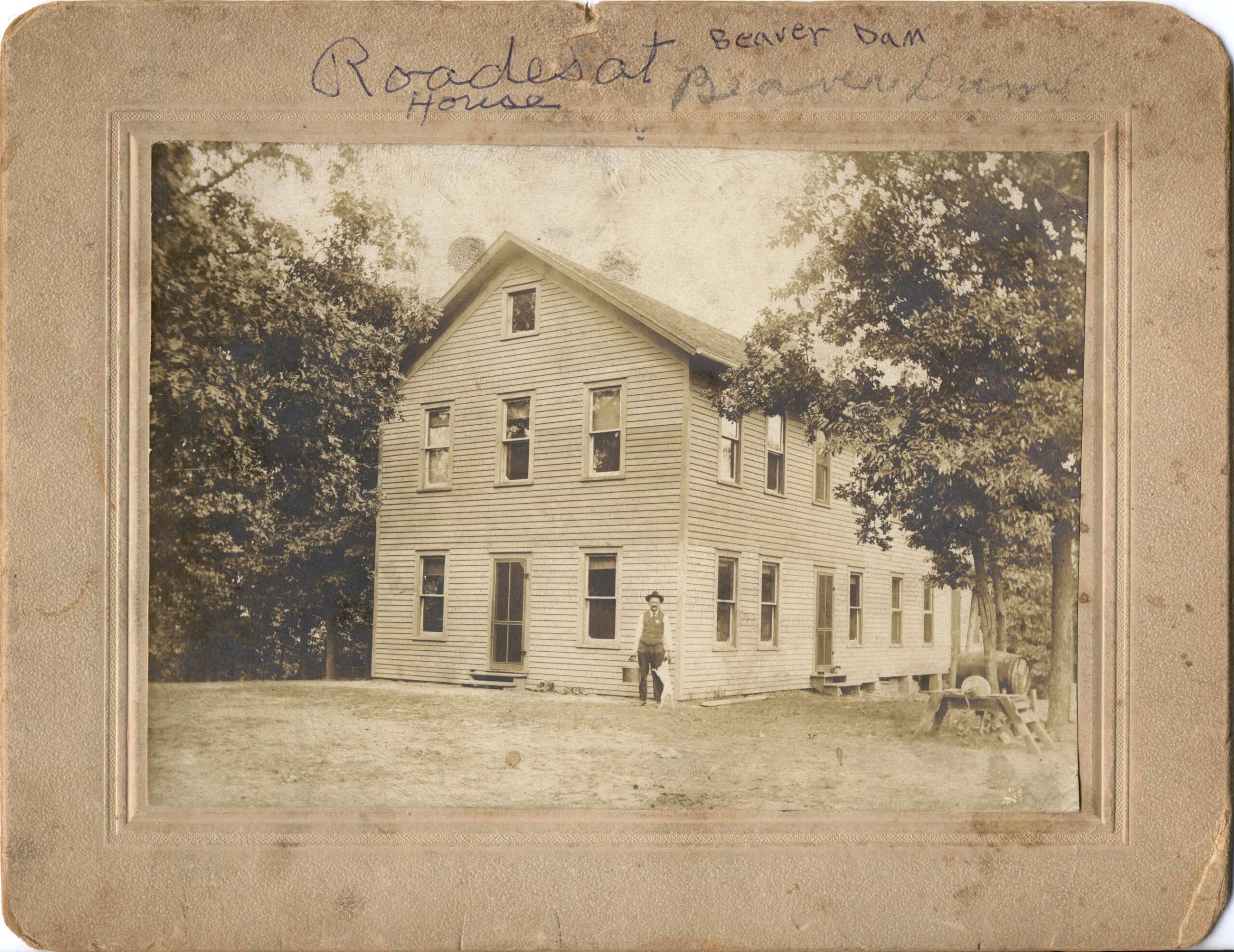
A century ago, a hotel was a landmark at the area that became Beaver Dam State Park in south-central Macoupin County. The structure has lived on in various incarnations since it closed in 1938.
The two-story, sixteen-room building opened for business in 1906. The exterior of the white-frame structure was spartan in appearance, which likely reflected the interior. But the hotel was a favorite stopover for visitors to Beaver Dam Lake.
Advertisements for the hotel were found in the St. Louis, Alton, and Springfield papers and attracted guests from miles around. “There must have been some business there,” said Jim Frank of the Macoupin County Historical Society in an interview before his death in late 2024. “People came from all over to visit the lake and stay in the hotel.”
Frank, who lived south of Beaver Dam, notes that guests arrived by train from Macoupin Station, a mile to the north. “They would be met there by a horse-drawn coach,” he remarked. “That would take them up the hill to the hotel.”
Though the hotel was basic, its surroundings were scenic. A tree-lined lane met visitors on the approach to the building, which sat just inside the current park entrance, on the right.
The hotel was operated by Frank Rhoads and his wife Sarah, whose father, Henry Brayford, played a pivotal role in the development of the lake for recreational purposes.
In 1881, some eighteen leading Carlinville residents leased the property from Brayford to create the Beaver Dam Lake Club. The members spent an estimated $2600 to construct earthen dams on either end of the lake to raise the water level.
Brayford, a coal miner who began to sink a new mine in 1899, died of a lingering illness on Dec. 23, 1901 at age 84. When Frank and Sarah Rhoads inherited the property, they ended the lease to the Carlinville businessmen and built the hotel, which opened as the Beaver Dam Fishing Resort.
The Rhoads, who had no children, took extra steps to ensure their guests’ enjoyment. “Mrs. Rhoads was quite a musician,” said Frank. “There was a grand piano and an organ in the hotel parlor, and she would play those to entertain the visitors.”
It was not the only way in which Sarah Rhoads put her stamp on the hotel. When meals were served, she called the guests and fishermen inside by blowing a large fox horn that sounded across the lake. A taxidermist, her mounts of local wild animals were displayed in the hotel and in its guest rooms. She was also adept at photography and for a fee, provided photos of her guests and their catches of fish.
Guests to the lake could fish for a dollar per day, while lodging was two dollars per night. Outdoor camping was permitted, but Sarah, owing to customs of the day, would not allow female campers.
Some individuals tried to avoid the fishing fee by sneaking into the lake grounds. However, the Rhoads posted watchmen who would collect the fee as they scaled the fences.
The completion of the Shipman Blacktop in 1937 doomed the hotel, as many guests began to spend the day and drive home at night, rather than staying over. Fee fishing continued at the site for several years, In 1947, the state of Illinois acquired the 425-acre property, which opened to the public as a state park the following year.
The second floor of the hotel was torn off, and the rest was converted into a residence for park rangers. The state also reconstructed and raised the earthen dams to create a lake of 56.5 acres. In 1955, additional land was acquired, boosting the park to 737 acres.
When capital improvements were made to Beaver Dam State Park in the late 2000s, the old hotel structure was sold to area residents and moved off site. The building now sits on private property.
Tom Emery is a freelance writer and historical researcher from Carlinville, Ill. He may be reached at 217-710-8392 or ilcivilwar@yahoo.com.
Comments


